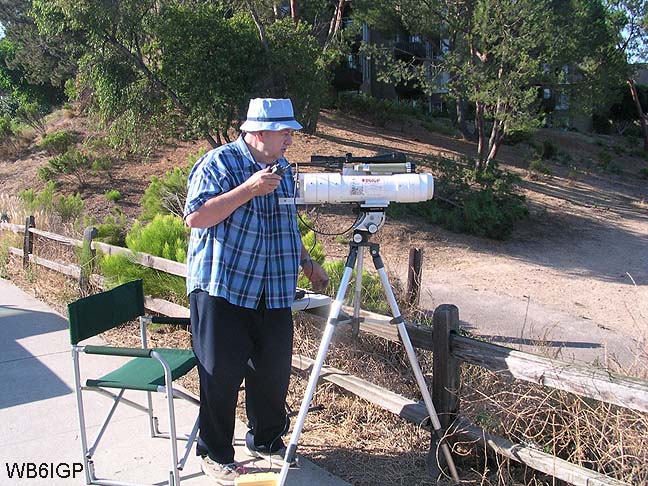
Chuck Houghton – WB6IGP

Chuck WB6IGP operating his lasercom system

Ed. note: This is a guest post by a good friend of mine, Tony Long, KC6QHP.  Hopefully Tony will be contributing more to the blog in the future and we’ll get to see some of the interesting things he’s working on in his lab in SoCal.  Let’s all welcome Tony to the blog! – Jeff

By 1995 I had been a licensed ‘ham’ for 4 years.  I was in the 11th grade and interested in a putting together a far-out science fair project.  Over the next two years I worked with two hams, mentors, and friends to get the project done.  One of them was Chuck Houghton, WB6IGP.  He and Kerry Banke N6IZW started the San Diego Microwave Group back in the 1980’s.  What they started was an informal group that still meets in the garage at Kerry’s house in La Mesa once a month to talk about and work on microwave ham radio projects.  This group has been highly influential in the interests and careers of myself and Jeff.  We both went to college in San Diego and attended these meetings and just as importantly, had a great source of parts and articles from Chuck.

Chuck, who was 68, passed away peacefully in his home on April 29th.

Chuck and Kerry started out on the microwave bands by using surplus microwave burglar alarm systems and modifying them for amateur radio use.  Chuck was in some ways an early version of many DIY electronics bloggers of today.  He not only did experiments, and built interesting projects, he wrote about them, told others how to do it, and supplied printed circuit boards, kits of parts, and so on.  He wrote a monthly column in 73 magazine and later in CQ-VHF detailing his experiments.   His reach was worldwide, and no doubt has enabled the microwave amaetur radio hobby to flourish.

So, to Chuck I bid a farewell and 73.  You will be missed but you will be remembered well!

-Tony KC6QHP

DIY TiVo IR Blaster

DIY TiVo IR Blaster

Recently I discovered that our local cable provider will soon be discontinuing analog cable service for most channels.   Because of this they are forcing encouraging customers to get new cable boxes and upgrade to digital cable.

I hate cable boxes.  More than just another piece of equipment to find a place for near the television, cable boxes waste power, always seem to take forever to change channels, contribute to the ball of wires behind the entertainment center, and add another remote control to the coffee table.

Most importantly, a cable box prevents our old Series 2 TiVo from being able to change channels directly, since it now has to negotiate with the digital cable box to receive TV signals.

TiVo provides a workaround for this – the infamous IR blaster.

I would love to meet the engineer who came up with the IR blaster.  Instead of pushing for a universal protocol to electrically connect cable boxes to things that may want to control them, some engineer came up with the incredibly stupid great idea to stick an IR LED in front of the IR receiver of the cable box and use it to simulate a handheld IR remote control.  The cable box thinks that the user is punching away at the remote (with lightning speed) while in reality a microprocessor is generating the remote codes and sending them to the LED.  It’s both ingenious, and at the same horrific in so many ways.  It grates against my engineering sensibility.  What manager approved this?

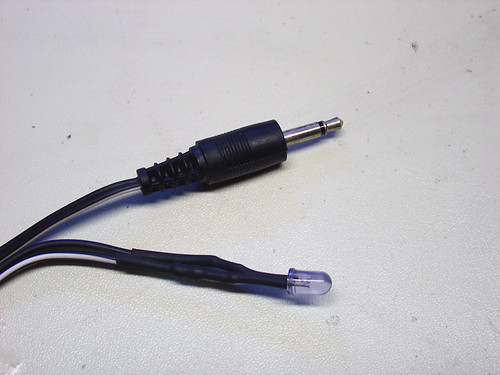
Back to the TiVo.  The IR blaster that came with our TiVo was lost long ago, in a time when no unnecessary electrical-optical-electrical sillyness was required for it to function.  Rather than spend $3 on eBay and wait a week to get a replacement, I decided to make one out of spare parts in my junk bin:

  • an infrared (IR) LED
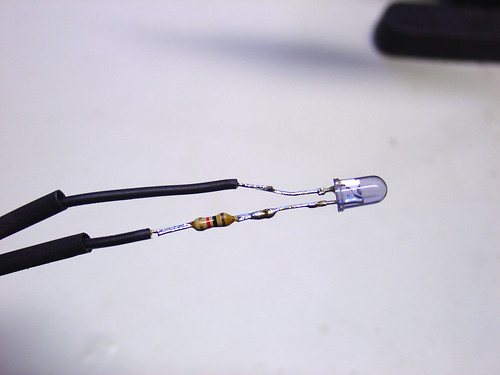
  • a 1k resistor (not sure if this is necessary, safety first)
  • a 1/8″ mono headphone plug with a couple feet of cable attached
  • some heatshrink tubing
  • duct tape

I don’t know if the resistor is required – the TiVo may already have an internal resistor.  I used 1k, if I see any problems with the cable box getting an intermittent signal I’ll try lowering the resistor to 330 ohms.

The tip of the 1/8″ mono plug is positive.  I connected the tip wire to the side of the LED with the longer lead (the side opposite the flat side of the LED).

DIY TiVo IR Blaster

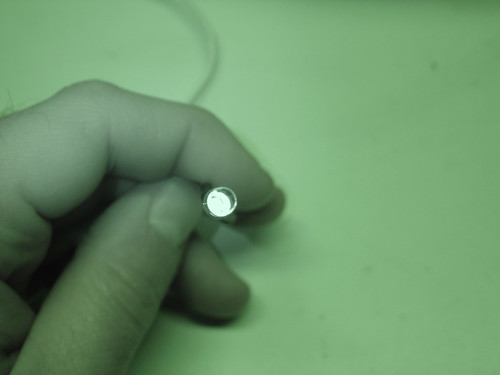
I tested the circuit by applying 3-5V to the 1/8″ plug (tip is positive) and used my digital camera to check if the LED is working.  My camera has a decent IR blocking filter so I had to use nightshot mode to see it:

DIY TiVo IR Blaster

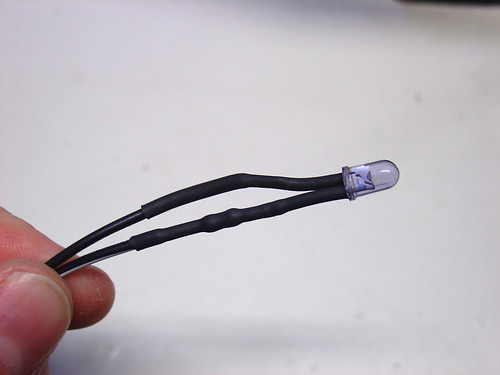
Finally, I put heatshrink over the LED connections and the resistor to avoid short circuits:

DIY TiVo IR Blaster

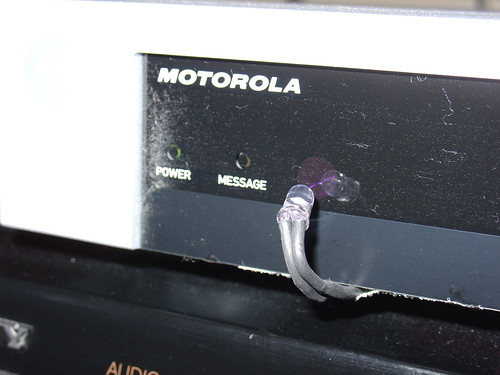
Back in the living room I plugged the DIY IR blaster into the jack marked ‘IR’ on the back of my TiVo.   A strip of duct tape to secures the wires to the bottom of the cable box.  I bent the LED up to point at the cable box’s IR receiver (the purple dot shown in the really bad photo below, sorry).

DIY TiVo IR Blaster

All that was left was to configure the TiVo using the cable box setup guide.  Within a few minutes I had my TiVo controlling the cable box.  The DIY IR blaster works perfectly!

Not bad for $0 in parts (all stuff from my junk bin) and a few minutes of soldering.

Update November 2016: In the vast majority of applications, the series resistor is not required. The majority of IR blaster circuits built into A/V equipment (and video game consoles such as the Xbox) include built-in current limiting circuitry that makes the resistor unnecessary.

NOTACON Wrapup

This past weekend, Notacon 6 rocked Cleveland, Ohio with three days of hardware and software hacking, demo competitions, opportunities to meet interesting people, get free stuff (including an awesome consuite) and participate in the chaos of a hacker conference in the midwest.

This was my first trip to both Cleveland and Notacon – and it was totally worth it.

Notacon had a lot going on at once.  This worked really well for someone like me with a lot of interests and a short attention span.  Over the weekend I witnessed many things, including:

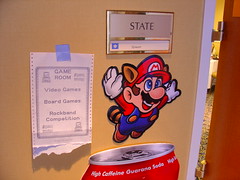
The Game Room

Hello Mario
C64
Game Room
Game Room

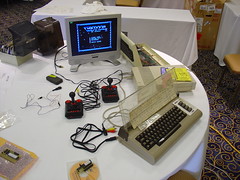
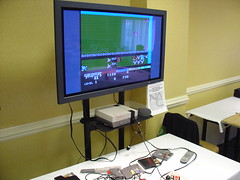
This was a room full of vintage and modern consoles, Rock Band, board games, and people having a good time.  I particularly enjoyed the Commodore 64 area which had some crazy hardware on display (C64 SD card to disk drive interfaces and some ROM hacks).

The Demo Room

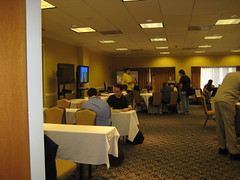
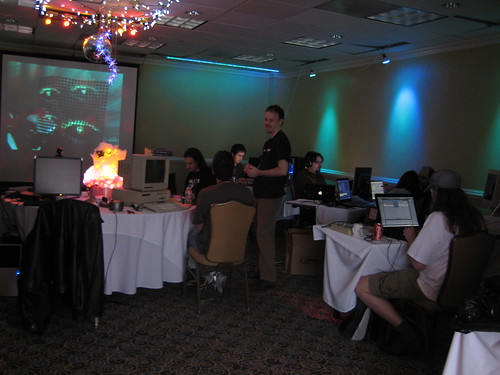
Demo Room

Here members of the demoscene put the finishing touches on their demos for Saturday night’s Blockparty Demo competition.  I think some demos were even conceived/written entirely in the demo room over the course of the weekend.

The Hackerspaces / Hardware Hacking Room

Electronics!
Neon LED
Brain Machine
Soldering Iron

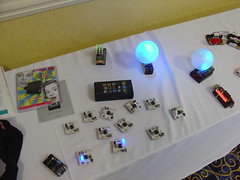
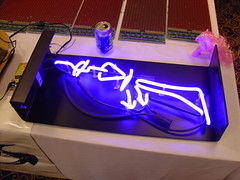
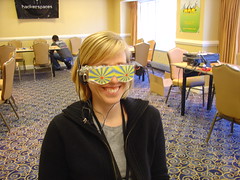
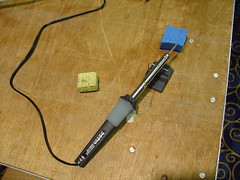
Kylie tried out Mitch Altman‘s  brain machine.  People were pretty much soldering things together all weekend.  There was a neon LED symbol.  It was cool.

Ham Radio Room

40m Lite II
40m Lite II

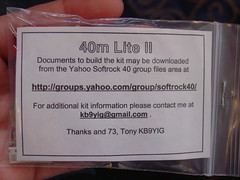
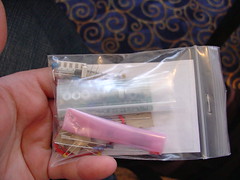
I bought a 40m Softrock Lite II kit from Christopher Pilkington (who also gave a talk on Hacking and Amateur Radio).   This kit receives 7 MHz radio signals and mixes them down to quadrature audio signals that can be decoded with a PC – a very cheap way to start playing with software defined radio.

There was an HF remote control setup for a radio on the roof and an amateur radio license exam on Sunday.  I was debating upgrading my license class to General, but sleep won out over the exam.

The Consuite

Free brownies.  ’nuff said.

Other Stuff

Blockparty also took place during Notacon.  I came to the con already pretty familiar with the demoscene, having owned an Amiga computer (a very popular platform for demos) in the 1990s.  15 years later, I found myself at North America’s longest running demo party watching demos being screened at 3AM in the morning.  How cool is that??

Kylie and I met Jeri Ellsworth and George Sanger, who produce a show about prototyping stuff called The Fat Man and Circuit Girl.   If you haven’t seen it yet, check it out.  They did a live show at Notacon that I found really inspirational.  More on that later.

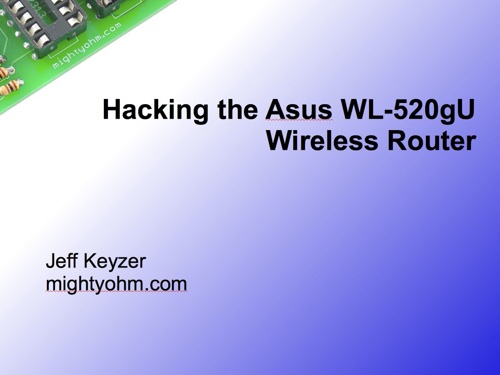
I gave a talk about Hacking the WL-520gU Wireless Router, and for my first talk at a major hacker conference I thought it went really well.  For now you can only download the slides, but eventually there should be links to videos of all the talks on the Notacon Media page.

In short: Great conference, great talks, great people.  It was awesome.  A+, would do it again.

NOTACON slides now available for download

jeff_keyzer-hacking_the_asus_wl520gu_scaled

I just uploaded the slides from my talk at NOTACON about Hacking the Asus WL-520gU Wireless Router.

Eventually a video of the talk will be available from the NOTACON media archive, but for now check out the slides to see some examples of what can be done with the Asus WL-520gU uber hacking platform.

If you have any questions about the talk, you can ask them over on the forums or contact me directly.