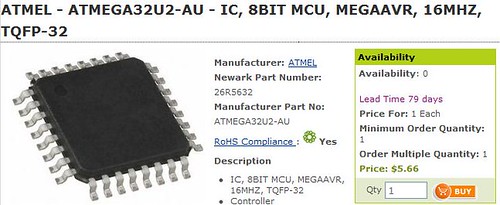
AVR Toolchain Installation Instructions for Windows, Mac OS X, Linux

Mitch Altman and I are in the process of writing a book about Making Cool Things with Microcontrollers (for people who know nothing.)

The book features several DIY projects that use AVR microcontrollers.  We’re aiming to teach absolute beginners how to solder, basic electronics, and the process of turning a cool idea into reality by using microcontrollers.

I wrote these instructions about setting up a working avr-gcc environment in Windows, Mac OS X, or Linux.  Mitch and I felt that they could use some beta testing in the real world before bring included in the book, so we decided to make them available here.  We also felt that they might help some people get started with AVRs before the book is available.

We want to make the process of writing and compiling code for the AVR simple and accessible, so we’re not using any fancy IDEs (eg. no AVR Studio).  We also wanted to use the same software on all three operating systems, so Windows-only tools were out.  Instead, we’re using avr-gcc, the compiler behind WinAVR, CrossPack, and Arduino.

I would appreciate any feedback on these instructions.

Here they are:

Windows

Mac OS X

Linux

Update: I totally rewrote this post after getting feedback that I didn’t properly identify my target audience and explain why I chose avr-gcc.  Sorry!
DIY Integrated Circuit Design with MOSIS

Photo: SATRE ELECTRONICS

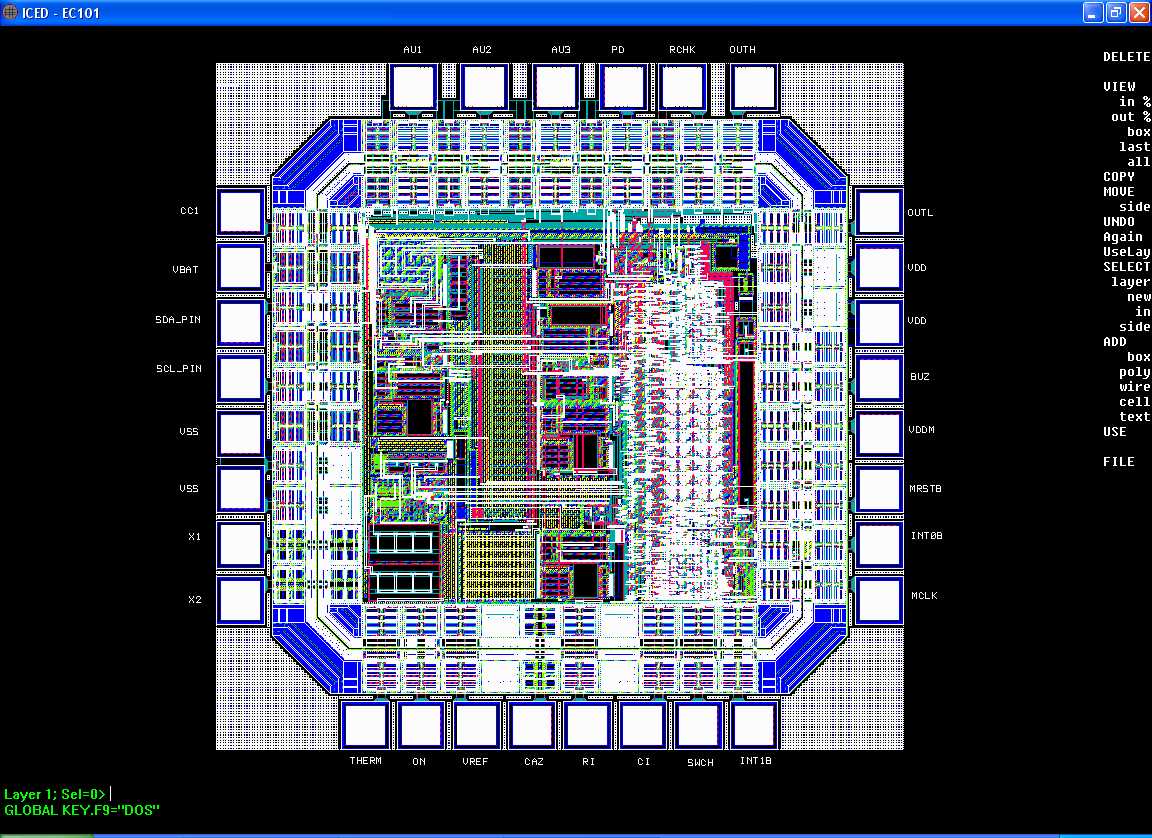
MOSIS, short for Metal Oxide Semiconductor Implementation Service, is to integrated circuits what BatchPCB is to printed circuit boards.  That is, it’s a batch order service that makes getting your own custom ICs fabricated more affordable by allowing lots of designers to contribute their designs and share the costs of a single IC fabrication run.

The difference in this case is that unlike your typical PCB pool, where a single board might cost $20, in IC-land, “affordable” means “tens of thousands of dollars’.”  For this reason, MOSIS is usually reserved for use by universities and startup companies, not by individuals.

However, that doesn’t mean that some particularly ambitious people haven’t used MOSIS to make their own chips before.

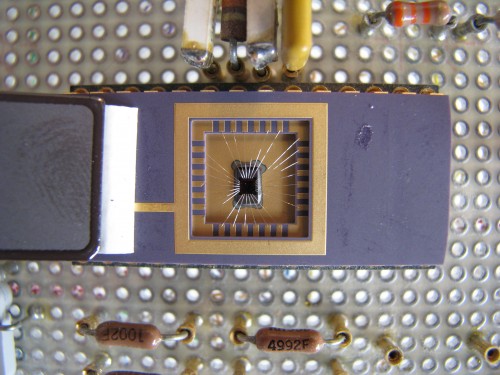
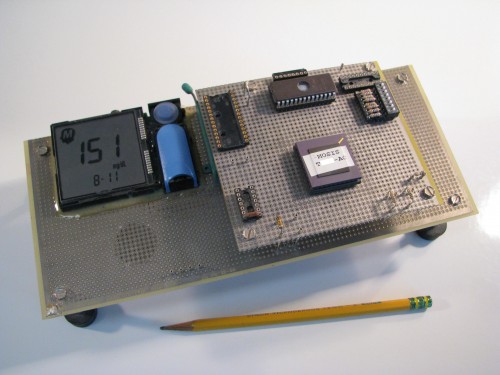
The photos that follow and the chip layout shown above are one example of an individual, Scot Satre of Satre Electronics, who in 2004 decided to design some of his own application-specific integreated circuits (see ASIC) in his spare-time.

Photo: SATRE ELECTRONICS

Photo: SATRE ELECTRONICS

I’m sure there have been others, but this is surely one of only a few examples of an individual having their own custom chips made.

I find this sort of thing very inspiring.  Will there be a time when individuals can submit their own chip designs to a multi-project wafer (MPW) like we submit PCB designs to group orders today?

Gold Phoenix makes BatchPCB possible by providing cheap offshore PCB fabrication services.  Where is the Gold Phoenix of semiconductor foundries that will make DIY IC design affordable for ordinary people and not just universities, corporations, and VC-funded startups?  Where are the free, open source tools that will enable you and I to simulate and layout our own chips?

If you could design your own integrated circuit, what would you make?

Photos: Scott Satre / Satre Electronics

Cheap Prototype PCBs from DorkbotPDX

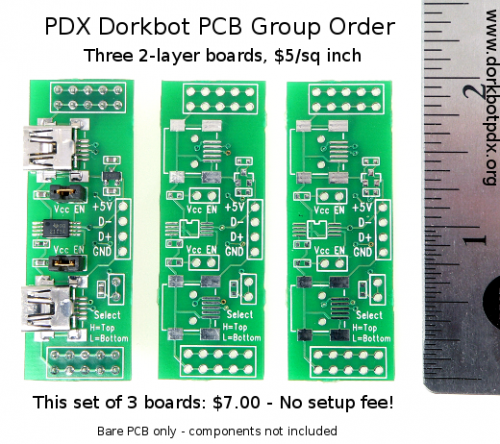
Three 2-layer  boards, $5/sq inch.  No setup fee!

Laen of DorkbotPDX has been running a PCB proto service for some time now, and I finally got a chance to try it out this month.

The pricing is simple.  For 2-layer boards, it’s $5 per square inch for three (3) PCBs, with no setup charge, and shipping is free.

The tunaround time is typically 9 days + first class mail shipping, which ends up being just under two weeks total fom PCB release to delivery in Austin.  This is pretty good for a group order, and signficantly faster than BatchPCB (based on my experience).

The only downsides that I am aware of are:

  • PCB orders only go out once a month, unless there is enough demand to justify a 2nd run.
  • If you wait too long, the panels can fill up.  Again, if there is enough demand, sometimes a 2nd panel can be added, but don’t count on it.
  • The soldermask and silkscreen can be any color (and you don’t get to choose!)  BatchPCB at least guarantees the standard white/green.

4-layer boards are available as well, but at a higher cost ($10/square inch) and less frequent intervals.

Entries for the next PCB order are due on October 25th.  The more orders Laen gets, the more likely he is to continue the service, so if you have some designs you’ve been thinking about but have been put off by expensive PCB costs, finish them up and get some boards made!