Dorkbot-SF Meeting Tuesday, 01/13/09

Dorkbot-SF is holding their next meeting at Monkeybrains next Tuesday, 1/13, at 7:30PM.

Here’s a summary of the talks for next week, hope to see you there!

Joe Grand – The Projects of Prototype This

Designing and building projects is hard. Designing and building projects of things that have never been done before is harder. Designing and building projects of things that have never been done before with the financial and time constraints of television is verging on ridiculous.

For 18 months, I was a co-host of Prototype This on Discovery Channel, an engineering entertainment program that followed the real-life design process of a unique prototype every episode. Comprised of an electrical engineer (that’s me), a roboticist, a material scientist, and special effects guy, we had the major bases covered and would often join forces with outside resources. We filmed thirteen episodes in very challenging conditions and that single season has almost finished airing.

In this mostly visual presentation, I’ll go through design details and show never-before-seen pictures and videos related to some of my favorite episodes, including the Traffic-Busting Truck, Fire Fighter PyroPack, and Virtual Sea Adventure, each of which had to be designed and built in a matter of weeks.

Joe Grand (aka Kingpin) is an electrical engineer, hardware hacker, and president of Grand Idea Studio, Inc., where he specializes in the invention, design, and licensing of consumer products, video game accessories, and modules for electronics hobbyists. He also spent many years as part of hacker collective L0pht Heavy Industries in Boston finding security flaws in hardware devices and educating engineers on how to increase security of their designs. He.s written a few books, holds a few patents, and is also the sole proprietor of Kingpin Empire, a project that gives back to the technology and health communities through charitable donations. His contributions to Prototype This can be found on his site at: www.grandideastudio.com/prototype-this.

http://www.grandideastudio.com
http://www.kingpinempire.com

Michael Ang – Gigapixels: Practice and Aesthetics

Creating images with gigapixel (1 billion pixel) resolution is now within the reach of anyone with a digital camera and computer. Picture taking robots such as the GigaPan can automatically take many overlapping pictures of a given scene. The individual pictures can be automatically stitched together to create a large final image. What are the aesthetics of this newly accessible medium? How does stitching together many small images differ from taking one very large one?

Michael (aka “Mang”) first used the GigaPan in the summer of 2007, when he took a prototype unit from Moffett Field to Alaska by pickup truck. This talk presents some of his work with robotically assisted photography. Practical aspects of creating large panoramas will be presented as well less straightforward uses of the technology.

Mang holds a BASc in Computer Engineering from the University of Waterloo in Canada and a Master’s Degree from NYU’s Interactive Telecommunications program. His interests include the intersection of technology, art and physical experience.

http://www.michaelang.com
Gigapan.org

Paul Cesewski (aka Paul da Plumber)- Fun is the Universal Language

Explore a carnival of interactive machines. People powered contraptions delight and amuse. New and used materials are used in a kind of contemporary alchemy. The re-animation of yesterdays dreams.

Paul’s work focuses on interactive sculptures. He has worked in general contracting work, fabrication, and high-end construction for the last twenty years and has built many commissioned public art projects in the context of his own work, on collaborations, and as part of San Francisco’s Bike Rodeo.

Some of Paul’s installations include: Bicycle Ferris Wheel and Bike to the Moon, Cyclefuge, Lotus Land, etc.
http://www.paulsrides.com

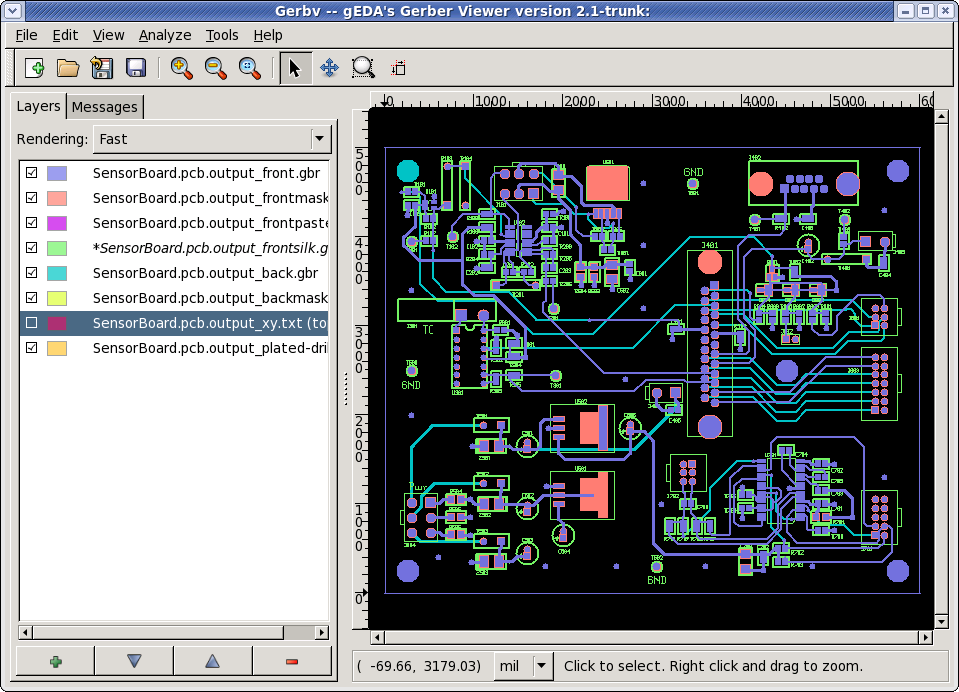
gerbv – A free, open source gerber viewer for Linux / OS X

When you finish a PCB design, you typically use the CAM export function of your layout tool to generate a set of gerber files to send to the PCB manufacturer.  To avoid errors in the finished board, it’s usually a good idea to review the files before you click send.

Enter gerbv, a free, open source gerber viewer that is available for many platforms, including Debian and OS X (via fink).

I recently upgraded to version 2.0 (I was using the really outdated version 1.0 on Macports) and I am really impressed by the improvements in the GUI and overall usability.

gerbv is a part of the gEDA suite, which also includes layout and schematic capture tools that are slowly becoming more popular vs. more established non-free tools like Eagle.

Update: I missed an interesting update to a post over on My 2uf, not everyone seems to like the rest of the gEDA suite.

gerbv screenshot
gerbv screenshot

AVR HV Programmer Shield in the Works!

hvfuse_shield3_brd
AVR HV Programmer Shield PCB Layout

What’s this???

In response to the continued demand for a PCB version of my Arduino-based AVR High Voltage Programmer, I just released a first cut to BatchPCB and should have a prototype within 3-4 weeks.

This design is an improvement upon the original HV programmer shield in the following areas:

  • Onboard 12V boost converter eliminates the need for an external 12V power supply
  • Support for two of the most common families of AVR microcontrollers, the ATmega48/88/168 and ATtiny2313
  • Separate Ready and Burn indicators
  • Protection resistors on every single data, control, and supply line to the target AVR, meaning that your Arduino and AVR should survive any mishaps during programming, including inserting the AVR backwards or off by 1 pin.

I hope to have kits for sale in early February.  Sorry for the delay in getting these made, but I wanted to make the best possible shield I could!

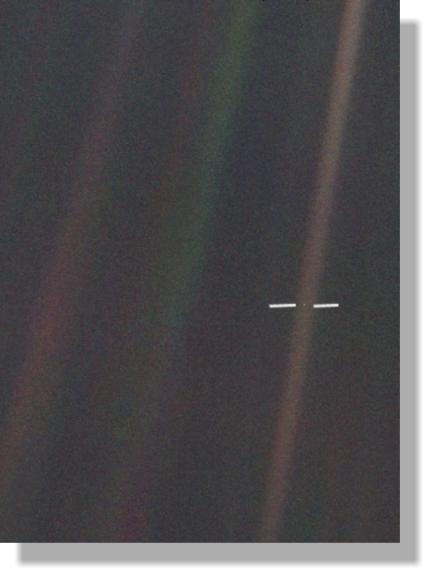
The Pale Blue Dot

Photo credit: http://www.bigskyastroclub.org/pale_blue_dot.htm
Photo credit: Big Sky Astro Club (http://www.bigskyastroclub.org/pale_blue_dot.htm)

Carl Sagan on the Pale Blue Dot:

Look again at that dot. That’s here. That’s home. That’s us. On it everyone you love, everyone you know, everyone you ever heard of, every human being who ever was, lived out their lives. The aggregate of our joy and suffering, thousands of confident religions, ideologies, and economic doctrines, every hunter and forager, every hero and coward, every creator and destroyer of civilization, every king and peasant, every young couple in love, every mother and father, hopeful child, inventor and explorer, every teacher of morals, every corrupt politician, every “superstar,” every “supreme leader,” every saint and sinner in the history of our species lived there – on a mote of dust suspended in a sunbeam.

The Earth is a very small stage in a vast cosmic arena. Think of the rivers of blood spilled by all those generals and emperors so that, in glory and triumph, they could become the momentary masters of a fraction of a dot. Think of the endless cruelties visited by the inhabitants of one corner of this pixel on the scarcely distinguishable inhabitants of some other corner, how frequent their misunderstandings, how eager they are to kill one another, how fervent their hatreds.

Our posturings, our imagined self-importance, the delusion that we have some privileged position in the Universe, are challenged by this point of pale light. Our planet is a lonely speck in the great enveloping cosmic dark. In our obscurity, in all this vastness, there is no hint that help will come from elsewhere to save us from ourselves.

The Earth is the only world known so far to harbor life. There is nowhere else, at least in the near future, to which our species could migrate. Visit, yes. Settle, not yet. Like it or not, for the moment the Earth is where we make our stand.

It has been said that astronomy is a humbling and character-building experience. There is perhaps no better demonstration of the folly of human conceits than this distant image of our tiny world. To me, it underscores our responsibility to deal more kindly with one another, and to preserve and cherish the pale blue dot, the only home we’ve ever known.