
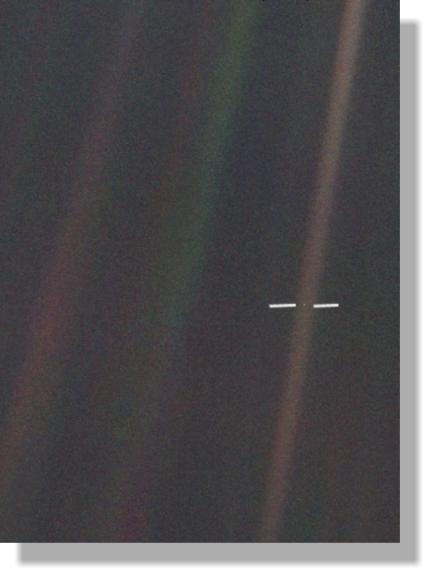
The Pale Blue Dot

Photo credit: http://www.bigskyastroclub.org/pale_blue_dot.htm
Photo credit: Big Sky Astro Club (http://www.bigskyastroclub.org/pale_blue_dot.htm)

Carl Sagan on the Pale Blue Dot:

Look again at that dot. That’s here. That’s home. That’s us. On it everyone you love, everyone you know, everyone you ever heard of, every human being who ever was, lived out their lives. The aggregate of our joy and suffering, thousands of confident religions, ideologies, and economic doctrines, every hunter and forager, every hero and coward, every creator and destroyer of civilization, every king and peasant, every young couple in love, every mother and father, hopeful child, inventor and explorer, every teacher of morals, every corrupt politician, every “superstar,” every “supreme leader,” every saint and sinner in the history of our species lived there – on a mote of dust suspended in a sunbeam.

The Earth is a very small stage in a vast cosmic arena. Think of the rivers of blood spilled by all those generals and emperors so that, in glory and triumph, they could become the momentary masters of a fraction of a dot. Think of the endless cruelties visited by the inhabitants of one corner of this pixel on the scarcely distinguishable inhabitants of some other corner, how frequent their misunderstandings, how eager they are to kill one another, how fervent their hatreds.

Our posturings, our imagined self-importance, the delusion that we have some privileged position in the Universe, are challenged by this point of pale light. Our planet is a lonely speck in the great enveloping cosmic dark. In our obscurity, in all this vastness, there is no hint that help will come from elsewhere to save us from ourselves.

The Earth is the only world known so far to harbor life. There is nowhere else, at least in the near future, to which our species could migrate. Visit, yes. Settle, not yet. Like it or not, for the moment the Earth is where we make our stand.

It has been said that astronomy is a humbling and character-building experience. There is perhaps no better demonstration of the folly of human conceits than this distant image of our tiny world. To me, it underscores our responsibility to deal more kindly with one another, and to preserve and cherish the pale blue dot, the only home we’ve ever known.
Free IPC-7351 Land Pattern Calculator

Let’s say you are designing a printed circuit board in Eagle, and you need to place a component that you’ve never used before.  In Eagle, before you can use a new component, you need a land pattern, a schematic symbol, and a mapping between them to fully define the part.  Often, you can search through Eagle’s included libraries and find what you need (or something close enough).  But what if that fails?

The symbol and pin definitions are usually pretty easy – just copy the datasheet.  The hard part is the land pattern: the collection of copper traces, soldermask openings, silkscreen, and other features that define the part on the PCB.

To come up with a land pattern, you usually have a few options:

  1. Someone else may have done you a big favor by creating a part definition and uploading it to the Eagle library directoryCaveat: Use it at your own risk.  Surface mount parts tend to be particularly hard to use right out of the box – often someone else’s land pattern won’t even pass your DRC.  Whose process were they using, anyway??
  2. Look through the datasheet for the part to try and find a recommended land pattern. (Good luck!  Increasingly these are not included, but may be somewhere else on the manufacturer’s website.  Google is your friend!)
  3. Take a guess based on the geometry of the part, assuming you have a mechanical drawing or a physical sample somewhere.
  4. Skip 1-3 and use an IPC-7351 land pattern generator.

IPC-7351 is a standard for printed circuit board land pattern designs.  The standard attempts to, well, standardize land patterns to try to discourage every PCB designer from having his or her own custom library of land patterns.  IPC takes known good land patterns and combines them with accepted manufacturing tolerances to produce a land pattern that will work for most people most of the time.  Increasingly you will see references to IPC-7351 in datasheets instead of a land pattern drawing, so access to the standard is becoming more important over time.

Cool, right?  Well, the bad news is that while you can browse through the table of contents/introducton for free, downloading the standard costs big bucks.

Fortunately, PCB Matrix has a free IPC-7351 Land Pattern Calculator (direct download link here) that you can use to generate land patterns based on the standard.  You don’t need to own a copy of the standard to benefit from it.

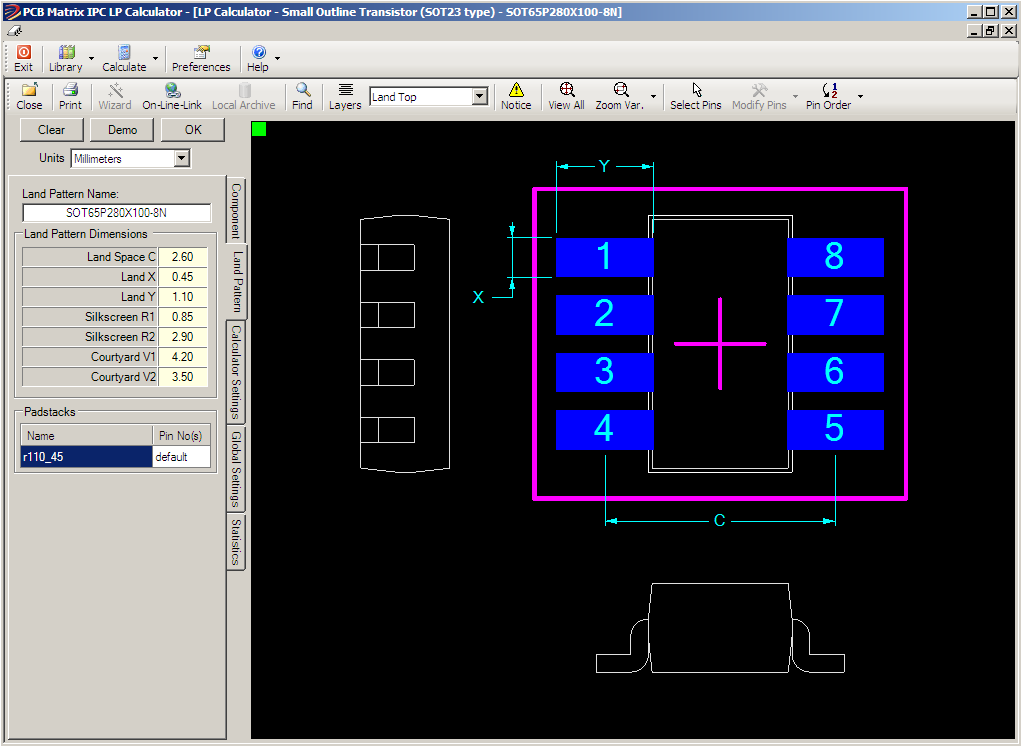
The calculator is somewhat tricky to use but if you click the right buttons you can get something like what is shown below (click to enlarge).

Thin SOT23 8-pin Package Land Pattern Screenshot
PCB Matrix IPC-7351 Land Pattern Calculator Screenshot

X and Y are the dimensions of the recommended pads for an 8-lead Thin SOT-23, which happens to be the package for the LT3464.

With this information, you can return to Eagle and create a land pattern for your device.  PCB Matrix will also sell you premade Eagle libraries, but from their site it was not clear how much they cost.  Based on their other products, my guess is several hundred dollars and a yearly maintenance contract – I’ll draw my own, thanks.

Unfortunately, the calculator is Windows only, so Mac guys like me need to use VMware Fusion or similar to use it.  Can someone create a web version, please?

Merry Book-mas

This Christmas I received a bunch of great books from friends and family.  My O’Reilly collection in particular doubled in size!

Here’s a list of what I’ll be reading in 2009:

Will 2009 be the Year of the Hacker?

Kevin Kelleher wrote an interesting post the other day on emerging technology blog GigaOM, entitled 2009: Year of the Hacker.

Kevin’s theory is that members of the growing ranks of unemployed professionals will choose to apply their “spare cycles” towards new and innovative projects after being released from the daily grind of full time employment.

Kevin writes:

I wonder what kind of creativity could be unleashed by workers who, though deprived of a steady paycheck, are freed from such tedious tasks. Some could come up with new ideas that help vault the web to a more advanced stage. Others may make micro-contributions that are equally powerful in aggregate. Such creativity could then foster an entirely new generation of startups, which would eventually lure away some of those who had remained at steady jobs all along.

I agree with Kevin because I have seen the beginnings of this trend firsthand.   Several of my colleagues in San Francisco left or lost their jobs this year, and not a single one sat at home eating potato chips.  Why?  Kevin quotes Chris Anderson, who writes:

… I think you’ll see a boom in creativity and sharing online as people take matters into their own hands. Today, if you’re in-between jobs you can still be productive, and the reputational currency you earn may pay dividends in the form of a better job when the economy recovers.

This reputational currency is real, and it is a direct result of the ease of collaboration and the almost zero barrier to entry in software (and increasingly hardware) development.  The tools are cheap or free, high speed internet is everywhere, and somewhere out there someone is interested in helping to bring your project to life.  It is becoming easier than ever to innovate in your own garage.  Don’t have a garage?  Use someone else’s instead.

The dividends have yet to been seen, but I am optimistic that efforts today will be repaid tenfold tomorrow.

Join the resistance.