Tag Archives: Electronics

Tony’s Diamond Chop Saw (Part 1)

dicer_small
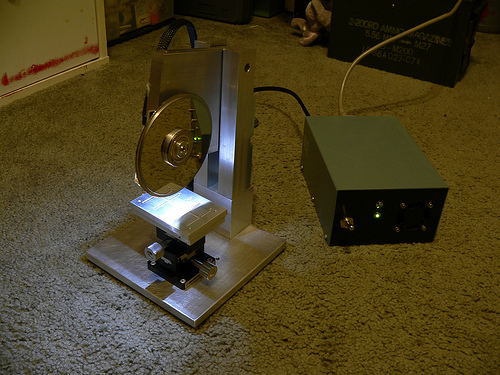
This is guest blogger Tony reporting on my latest project, a very small, precise circular chop saw.  Why would anyone want to build such a saw you might ask?  Well, to make parts for another project of course!

So here’s the background….I’m building a ham radio that operates at 47 GHz.  At such a high frequency there are very few components that can be soldered on to circuit boards, let alone components that even come packaged!  The easiest way to build a high performance radio at these frequencies is to use MMICs (Monolithic Microwave Integrated Circuits).   These are really just fancy, yet fairly simple circuits made from exotic materials, most commonly Gallium Arsenide (GaAs) instead of the usual Silicon used for normal chips.  Before MMICs were in widespread use, individual transistors had to be used, requiring delicate and hard to make external matching elements.  MMICs are like nice little 50 ohm building blocks.  Low Noise Amplifiers (LNAs), mixers, Power Amplifiers (PAs), phase shifters, etc. etc. are all available in this form.  Trouble is that you have to connect these pieces up to make a functional radio (or at least the microwave portion of it).
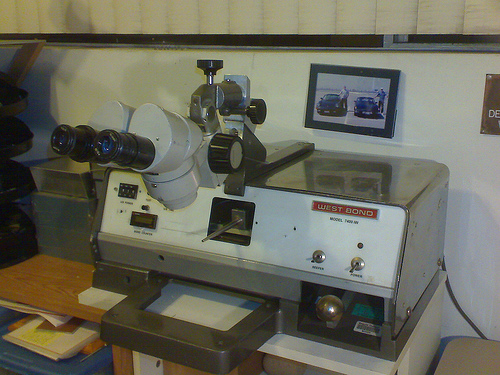
My WestBond wedge bonder

Wire bonding is the usual method for connection and is really just a method of welding a wire (or ribbon) from one chip to the next.  It turns out that you actually need space in between the chips, for thermal reasons, RF reasons, and for placing the requisite bypass capacitors.  So what goes in between the chips?  Well, coax cable is pretty much out, and most common circuit board materials start getting pretty lossy at 10+ GHz, and even the good stuff (PTFE-based usually) starts getting kinda lousy at 40+ GHz.   At very high frequencies, materials like ceramics and quartz become worthwhile.  In my radio I chose to use pre-made alumina ceramic substrates (tiny circuit boards).   These come with a gold layer on the back, and a gold line on top etched to perform as a 50 ohm transmission line (just like coax and just what the MMICs want to see).  I bought these with a number of other hams last year in a group buy.  They are fairly expensive being that they are 5 and 10 mils thick!
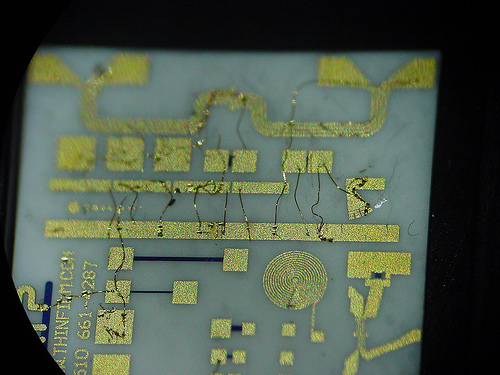
test bonds
My first test bonds on an alumina ceramic substrate (ugly)

To make the best use of the sections that I bought I decided I needed to cut them to length.  Well how do I do that?  The thickest pieces are 10 mils thick (a piece of printer paper is 4 mils thick) and they are brittle!  Beyond cutting, how do I hold the piece while cutting and when it’s done?  The resulting pieces may be just 100 mils long, and 50 mils wide.   Obviously a pair of vice-grips simply won’t do.

So my first thought was a Dremel tool and tape.  This method could work, but it does not lend itself well to making measured cuts.  At 47 GHz, a few hundredths of an inch is a lot! Also, the available diamond blades for dremel tools are fairly wide and I wanted to waste as little of the  small substrates as possible.  At this point I made  a lucky find on eBay.

In the semiconductor industry, one of the last steps of making a chip is called “wafer dicing.”  After a wafer full of chips is made, they need to be cut out into individual parts.  To do this, wafer dicing machines were developed.  These are CNC saws that use a high speed (as high as 60,000 rpm) air bearing spindles with diamond abrasive blades.   They can cut lines across large dinner plate sized wafers that are as narrow as only a few tens of microns.   Luckily there is enough wafer dicing going on in the world that there is a source of surplus blades on eBay.  Not all blades are well suited for all materials, so do some research if you are interested.  Disco (a Japanese company) is one of the largest dicing blade manufacturers.
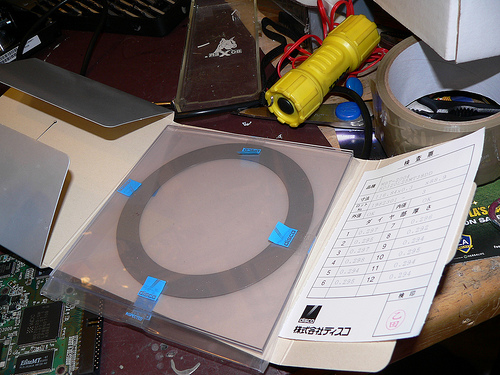
dicingblade
Large (4.6 inch diameter) wafer dicing blade in it's packaging.

While reading the last paragraph you may have spotted a few words indicating unobtanium.  Those words are “high speed air bearing spindle.”   Well I chose to use a hard drive motor instead, because they have excellent bearings and are readily availble  for free.  While they don’t move as fast, I don’t care.  I have a few short cuts to make, not millions of chips.

So that is an introduction to what I’m doing.  For the most part the saw has been built using surplus parts and remnant pieces of metal from my favorite local metal supply house M&K Metals in lovely Gardena, CA.   As of this entry, the saw is nearly complete, all that is left is the splash guards.  I’ll be posting the build of this project in several parts, so stay tuned.

And a link to my Flickr photo set for this project: Dicing saw

-Tony
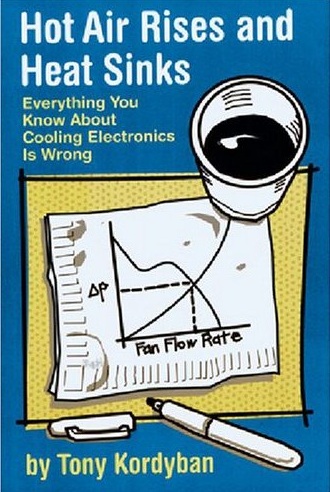
Book Review: Hot Air Rises and Heat Sinks, by Tony Kordyban

Everything You Know About Cooling Electronics Is Wrong
Everything You Know About Cooling Electronics Is Wrong!

Working as an electrical engineer, I have often been faced with thermal design problems. They are usually in the form of: “Given a maximum system temperature X, ensure that the maximum temperature of all devices in the design does not exceed Y.”  Temperature X is usually a customer spec, while temperature Y is almost always driven by MTTF constraints on the semiconductors used in the design.  This sounds simple enough until you realize that:

  • The system temperature is often not clearly defined.  Is it the ambient air temperature?  The temperature of the printed circuit board the part is mounted on?  The temperature of a baseplate (usually a sizable piece of aluminum) that won’t even exist in the finished design?
  • The MTTF spec is usually based on things you can’t measure directly (at least not easily or accurately), like the junction temperature of a transistor that is on a die you can’t even see, inside a package you don’t have a thermal model for.  In addition, MTTF numbers are often wildly inaccurate, don’t account for duty cycle, etc.  Yikes.
  • Chances are, the guy who worked on the part before you hasn’t checked the thermal readings in years, so it’s actually running way over the limits, and now you have to fix it.  A small change in the design can drastically affect the numbers

At the end of the day, numbers are scribbled on envelopes or entered into spreadsheets, guesses estimates are made, and everyone resolves to develop a better thermal model next time, which of course never happens.

I stumbled upon this book at the Stanford University Bookstore a few months ago.  Given my experience (frustration) with thermal design, I couldn’t help but pick it up and start reading.

It’s a fairly quick read and thoroughly entertaining.  Kordyban’s style is very informal.  The chapters are in the form of several short stories about fictional characters at a made-up company called TeleLeap.  These characters have to solve a series of design problems, which are used as examples to explain several concepts of thermal design.  There are no lengthy derivations and the technical discussions are pretty understandable, even to someone who never took thermodynamics in college (like me).

In particular, I found Kordyban’s discussions of the errors that can creep into thermocouple measurements, the difficulty of measuring junction temperature directly, and the problem with pin-fin heatsinks very interesting and educational.  I won’t say that I am an expert in thermal design having read this book, but I do have just a little bit more insight into what’s going on (and what to avoid).

Unfortunately, the book is out of print, so you’ll have to find a used copy and pay some big bucks – unless you get lucky like I did and find one that’s still sitting on the shelf.  No, you can’t have mine!

Hot Air Rises and Heat Sinks: Everything You Know About Cooling Electronics Is Wrong

The Fat Man and Circuit Girl

The Fat Man and Circuit Girl Cast 9 from Jeri Ellsworth on Vimeo.

I don’t know why it took so long, but recently someone turned me onto The Fat Man and Circuit Girl show, which has been airing on the net for almost six months now.  This is definitely the quirkiest and most entertaining electronics themed webcast I have ever seen.  The episode above includes an awesome segment about making a floppy drive reverb machine and thoughts on brewing coffee with PID, which reminded me of some other projects I have worked on…

The Fat Man and Circuit Girl are:

George Sanger – (fatman.com)

Musician, artist, composer of music for several video games, most notably Maniac Mansion on the NES and Wing Commander.

Jeri Ellsworth – (blog, twitter, flickr, vimeo, youtube)

Self taught electrical engineer.  Designer of the C64 DTV.

I had a chance to meet George and Jeri at NOTACON in Cleveland this month.  They are as entertaining in person as they are on video!  Jeri told me that she will be at the Maker Faire in San Mateo this year, showing off her Easy-Bake Chip Lab.  I am really looking forward to seeing it!

They have a website for the show at fatmanandcircuitgirl.com.  You can also follow @fmandcg on twitter.

Who needs television when you can stream a show like this?

Los Angeles Area Surplus Tour

Last month I spent a weekend in LA visiting Tony, who is building an awesome wood veneered enclosure for my Wifi Radio project.

While I was there we spent a day checking out various electronics surplus shops in the area, several of which Tony had never visited before.

Here are the highlights of our tour:

All Electronics (Van Nuys, CA)

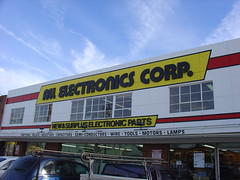
Most people know (or should know) of All Electronics as a catalog store with a long history in electronics and a decent website.  It turns out (I was surprised by this) that you can visit their retail store at 14928 Oxnard Street in Van Nuys.

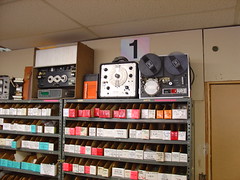
The store doubles as a makeshift electronics museum, with lots of vintage consumer and industrial equipment strewn around the room.

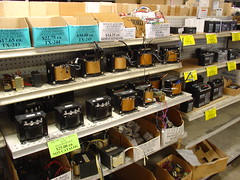
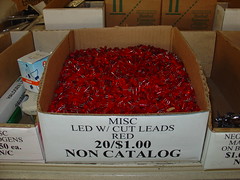
Stuff to look for: power supplies, handfuls of LEDs, reels of SMT components.

All Electronics
Xformers
LEDs
All Electronics

Apex Electronics (Sun Valley, CA)

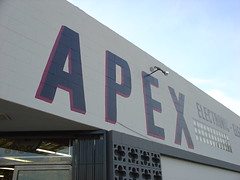
This is what surplus electronics is all about!  Absolute goldmine of bizarre electronics surplus equipment perched on the edge of civilization in Sun Valley.  Wire, motors, meters, huge capacitors, electronic components, antennas, hardware, strange military stuff, hydraulics, pneumatics, you name it.

This is probably the best place to find weird surplus electronics junk in all of California, now that most of the Silicon Valley greats are gone or closed to walk-in customers.

We budgeted an hour here and could have spent all day.  I would budget at least 2-3 hours or you won’t get to explore the whole store.

Need some decomissioned rocket launchers?  You’ll find them here.

More photos of Apex on flickr.

APEX
No idea.
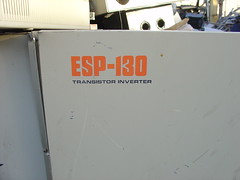
ESP-130 Transistor Inverter
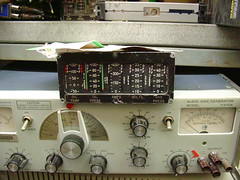
Flight instrumentation

Last year I posted about how surplus electronics junk is getting harder and harder to find in Silicon Valley.  Apex Electronics reminds me of RA Enterprises circa 1995 – mountains of electronics equipment waiting for someone to take home and turn into something new.

We didn’t get a chance to visit all of the places we wanted to thanks to LA’s signature traffic jams.  Next time I’m back I hope to find some new surplus goldmines and report back.

Suggestions?

Do you know of a place to find cool electronics junk in your area?

I know that the number of stores like Apex and All Electronics are dwindling as eBay and Digi-key take over.

Post in the comments and together we can try to keep these rare stores alive!

Forrest Mims Engineer’s Mini-Notebooks

Engineer's Mini-Notebook

I previously posted about Forrest M. Mims III’s Getting Started in Electronics, one of the best books out there for someone who wants a thorough, yet unintimidating introduction to electronic components and circuits.

From the mid-1980’s through the late 1990’s, Forrest Mims also published several mini-notebooks, each dedicated to a specific topic in electronics.  Each mini-notebook contains 50 pages of circuits, electronic concepts, and project ideas.

The complete set includes:

  • 555 Timer Circuits
  • Basic Semiconductor Circuits
  • Communications Projects
  • Digital Logic Circuits
  • Environmental Projects
  • Formulas, Tables, and Basic Circuits
  • Magnet and Sensor Projects
  • Op-amp IC Circuits
  • Optoelectronic Circuits
  • Schematic Symbols, Device Packages, Design and Testing
  • Science Projects
  • Sensor Projects
  • Solar Cell Projects

I had a few of the originals when I was growing up and wish I had kept more of them.  I specially remember reading the Optoelectronics Circuits Mini-Notebook in High School.  I attempted to build the optical communicator entirely with parts from Radio Shack, which was very difficult 15 years ago, and would be pretty much impossible today!

Updated/compiled versions of the notebooks are available on Forrest Mims’ website, but many of the originals can be found used for less than a few bucks each on amazon.com.