Jesper Haffgaard just sent in this Danish translation of the Soldering is Easy comic book.
Thanks, Jesper!

Jesper Haffgaard just sent in this Danish translation of the Soldering is Easy comic book.
Thanks, Jesper!
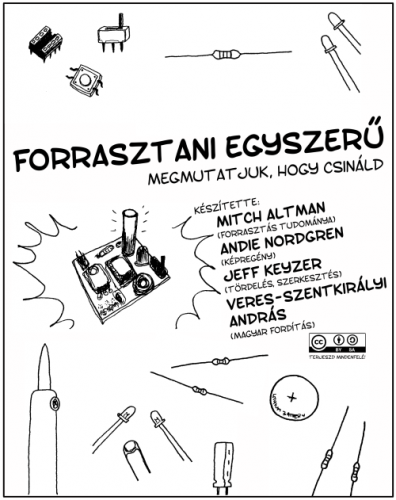
Back in April, dnet sent me this Hungarian translation of the Soldering is Easy comic book. It took me this long to finally add it to the list of translations. Sorry dnet!

Greg Peek and Dave Roberts made this awesome comic book to teach people how to solder surface mount components. Nice work, guys!
SMT Soldering was inspired by the Soldering is Easy comic book that I created with Mitch Altman and Andie Nordgren in 2011.

(photo credit: alvaroprieto)
This year I decided (in true last-minute fashion) to build a couple demos to show off my Geiger Counter kit at the Maker Faire Bay Area. One of these demos used my Geiger Counter kit to create ambient music:
(Thanks to @j_jwalrus for the interview and video!)
I used a five MightyOhm Geiger Counter kits, an Arduino Uno R3, a Sparkfun Music Instrument Shield, and an Adafruit Protoshield to make the demo.

The PULSE output of each Geiger counter is connected to one input of a 74LS04 hex inverter on the Protoshield. Each time a Geiger counter detects a radioactive decay, it sends a 0.1ms 3V high pulse to one input of the inverter. The 74LS04 functions as a level shifter and outputs an (inverted) 5V pulse that is suitable for driving an ordinary (5V) Arduino.
Five outputs of the 74LS04 are connected to input pins on the Arduino. For convenience, I used Analog inputs 0-1 as digital input pins. The rest of the gates are connected to digital pins 10-12.
I used the PinChangeInt library on the Arduino to trigger an interrupt handler every time a falling edge is detected on one of the geiger inputs. This interrupt handler stores the pin number to a variable and sets a flag to tell the main() function that something has happened.
The main() loop polls the interrupt flag and waits for something to happen. When it detects that an interrupt has occured, it sends a “Note On” midi message to the Music Instrument Shield, using the SoftwareSerial library built in to Arduino 1.0. I had to hack the library a bit to get it to work in conjuction with the PinChangeInt library, since the SoftwareSerial library automatically installs interrupts for all pins (bad, bad SoftwareSerial!)
The value of the note depends on which Geiger counter triggered the interrupt. In the video I am using note ‘C’ over five octaves, centered around middle C (midi note 60). (I am not a musician, but this seemed to provide a pleasing sound that wouldn’t annoy me or my neighbors at the Faire too much.)
The Arduino sketch is a complete disaster right now, having been thrown together at the last minute, but I plan to clean it up and post it soon.
Things I learned while creating this demo:
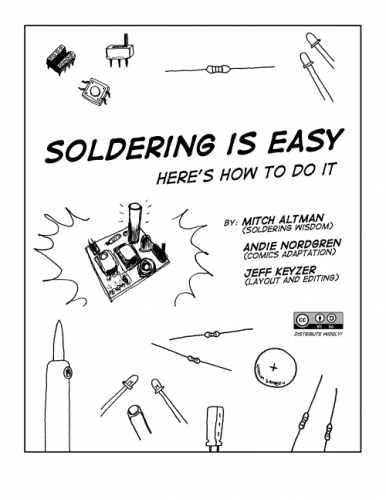
Today marks one year since Mitch Altman, Andie Nordgren and I released our Soldering is Easy comic book.
Since then it has been translated into 15 other languages (not including Morse Code) and has been downloaded more times than we can count (40,000 times in the first week alone).
I would like to extend our sincere thanks to all of the translators and to everyone else who has helped spread our comic book around the world. I’ve seen it at hacker conferences and Maker Faires, referenced in university electronics courses, and posted at hackerspaces in very far away places.
Thanks for making our comic book such a huge success, we couldn’t have done it without you!