
Let’s say you are designing a printed circuit board in Eagle, and you need to place a component that you’ve never used before. In Eagle, before you can use a new component, you need a land pattern, a schematic symbol, and a mapping between them to fully define the part. Often, you can search through Eagle’s included libraries and find what you need (or something close enough). But what if that fails?
The symbol and pin definitions are usually pretty easy – just copy the datasheet. The hard part is the land pattern: the collection of copper traces, soldermask openings, silkscreen, and other features that define the part on the PCB.
To come up with a land pattern, you usually have a few options:
- Someone else may have done you a big favor by creating a part definition and uploading it to the Eagle library directory. Caveat: Use it at your own risk. Surface mount parts tend to be particularly hard to use right out of the box – often someone else’s land pattern won’t even pass your DRC. Whose process were they using, anyway??
- Look through the datasheet for the part to try and find a recommended land pattern. (Good luck! Increasingly these are not included, but may be somewhere else on the manufacturer’s website. Google is your friend!)
- Take a guess based on the geometry of the part, assuming you have a mechanical drawing or a physical sample somewhere.
- Skip 1-3 and use an IPC-7351 land pattern generator.
IPC-7351 is a standard for printed circuit board land pattern designs. The standard attempts to, well, standardize land patterns to try to discourage every PCB designer from having his or her own custom library of land patterns. IPC takes known good land patterns and combines them with accepted manufacturing tolerances to produce a land pattern that will work for most people most of the time. Increasingly you will see references to IPC-7351 in datasheets instead of a land pattern drawing, so access to the standard is becoming more important over time.
Cool, right? Well, the bad news is that while you can browse through the table of contents/introducton for free, downloading the standard costs big bucks.
Fortunately, PCB Matrix has a free IPC-7351 Land Pattern Calculator (direct download link here) that you can use to generate land patterns based on the standard. You don’t need to own a copy of the standard to benefit from it.
The calculator is somewhat tricky to use but if you click the right buttons you can get something like what is shown below (click to enlarge).
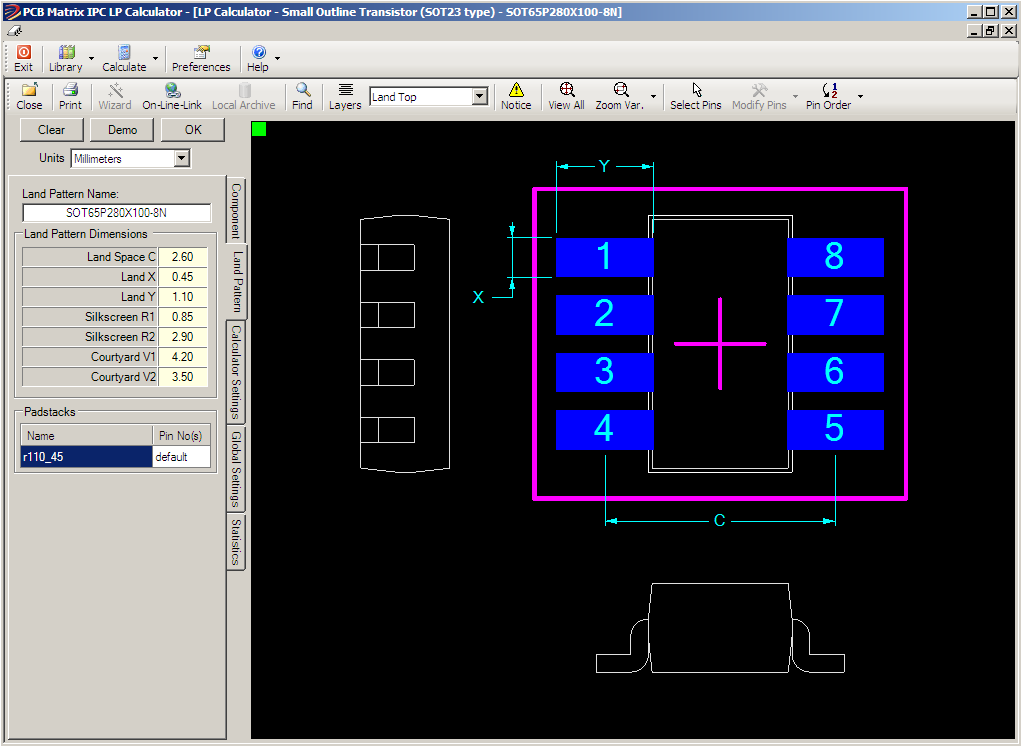
X and Y are the dimensions of the recommended pads for an 8-lead Thin SOT-23, which happens to be the package for the LT3464.
With this information, you can return to Eagle and create a land pattern for your device. PCB Matrix will also sell you premade Eagle libraries, but from their site it was not clear how much they cost. Based on their other products, my guess is several hundred dollars and a yearly maintenance contract – I’ll draw my own, thanks.
Unfortunately, the calculator is Windows only, so Mac guys like me need to use VMware Fusion or similar to use it. Can someone create a web version, please?
 – Several first hand accounts of what it takes to be a good analog circuit designer by leaders in the industry. An older book with lots of circuit examples and historical notes illustrating trade-offs, breakthroughs and the analog circuit design process. Discussion of the looming threats of digital circuits (20+ years ago!).
 – HTML has grown a lot since I started using it in 1995. This is my attempt to catch up.
 – So I can hopefully upgrade my web designer status from “hopeless hack” to “amateur”.
 – You can never have too many scripting langages at your disposal (can you?).
 – To give the right side of my brain something to do in between the previous four entries.

 , is probably the best book out there for someone who is starting out with the