Book Review: Hot Air Rises and Heat Sinks, by Tony Kordyban

Everything You Know About Cooling Electronics Is Wrong
Everything You Know About Cooling Electronics Is Wrong!

Working as an electrical engineer, I have often been faced with thermal design problems. They are usually in the form of: “Given a maximum system temperature X, ensure that the maximum temperature of all devices in the design does not exceed Y.”  Temperature X is usually a customer spec, while temperature Y is almost always driven by MTTF constraints on the semiconductors used in the design.  This sounds simple enough until you realize that:

  • The system temperature is often not clearly defined.  Is it the ambient air temperature?  The temperature of the printed circuit board the part is mounted on?  The temperature of a baseplate (usually a sizable piece of aluminum) that won’t even exist in the finished design?
  • The MTTF spec is usually based on things you can’t measure directly (at least not easily or accurately), like the junction temperature of a transistor that is on a die you can’t even see, inside a package you don’t have a thermal model for.  In addition, MTTF numbers are often wildly inaccurate, don’t account for duty cycle, etc.  Yikes.
  • Chances are, the guy who worked on the part before you hasn’t checked the thermal readings in years, so it’s actually running way over the limits, and now you have to fix it.  A small change in the design can drastically affect the numbers

At the end of the day, numbers are scribbled on envelopes or entered into spreadsheets, guesses estimates are made, and everyone resolves to develop a better thermal model next time, which of course never happens.

I stumbled upon this book at the Stanford University Bookstore a few months ago.  Given my experience (frustration) with thermal design, I couldn’t help but pick it up and start reading.

It’s a fairly quick read and thoroughly entertaining.  Kordyban’s style is very informal.  The chapters are in the form of several short stories about fictional characters at a made-up company called TeleLeap.  These characters have to solve a series of design problems, which are used as examples to explain several concepts of thermal design.  There are no lengthy derivations and the technical discussions are pretty understandable, even to someone who never took thermodynamics in college (like me).

In particular, I found Kordyban’s discussions of the errors that can creep into thermocouple measurements, the difficulty of measuring junction temperature directly, and the problem with pin-fin heatsinks very interesting and educational.  I won’t say that I am an expert in thermal design having read this book, but I do have just a little bit more insight into what’s going on (and what to avoid).

Unfortunately, the book is out of print, so you’ll have to find a used copy and pay some big bucks – unless you get lucky like I did and find one that’s still sitting on the shelf.  No, you can’t have mine!

Hot Air Rises and Heat Sinks: Everything You Know About Cooling Electronics Is Wrong

AVR, Eclipse and the Mac

Pete Harrison at Micromouse Online wrote a short tutorial about using Eclipse to program AVRs.   Eclipse is  an open source IDE that is supported on many platforms, including OS X on the Mac.

I have never used Eclipse myself, so I can’t vouch for how well this works, but I would like to upgrade from the command line tools I am using (part of AVRMacPack, which is now called CrossPack).  I could use Apple’s Xcode but last time I checked, the AVR integration in Xcode wasn’t that great.

Is anyone using Eclipse for AVR development? What do you like/dislike about it?

AVR, Eclipse and the Mac | Micromouse Online

The Fat Man and Circuit Girl

The Fat Man and Circuit Girl Cast 9 from Jeri Ellsworth on Vimeo.

I don’t know why it took so long, but recently someone turned me onto The Fat Man and Circuit Girl show, which has been airing on the net for almost six months now.  This is definitely the quirkiest and most entertaining electronics themed webcast I have ever seen.  The episode above includes an awesome segment about making a floppy drive reverb machine and thoughts on brewing coffee with PID, which reminded me of some other projects I have worked on…

The Fat Man and Circuit Girl are:

George Sanger – (fatman.com)

Musician, artist, composer of music for several video games, most notably Maniac Mansion on the NES and Wing Commander.

Jeri Ellsworth – (blog, twitter, flickr, vimeo, youtube)

Self taught electrical engineer.  Designer of the C64 DTV.

I had a chance to meet George and Jeri at NOTACON in Cleveland this month.  They are as entertaining in person as they are on video!  Jeri told me that she will be at the Maker Faire in San Mateo this year, showing off her Easy-Bake Chip Lab.  I am really looking forward to seeing it!

They have a website for the show at fatmanandcircuitgirl.com.  You can also follow @fmandcg on twitter.

Who needs television when you can stream a show like this?

APRS Tracker

APRS Tracker

This week, my brother is relocating from the San Francico Bay Area to Texarkana, Texas.  I’m helping him move, so for the next two weeks we’ll be on a road trip through California, Arizona, New Mexico, Texas, and maybe a little bit of Oklahoma.  We’re planning to see the Very Large Array, visit Truth or Consequences, and check out The Black Hole in Los Alamos.  That is, if the trailer stays connected and we don’t break down too many times on the way.

I though this would be a good opportunity to dust off my APRS tracker so friends and family can watch our progress.

What is APRS?

APRS, short for Automatic Packet Reporting System, is a radio network that uses amateur radio frequencies to relay short messages.  Think of it as a precursor to twitter, developed 20+ years ago by Bob Bruinga, WB4APR.  The messages usually contain GPS coordinates, and they are relayed via radio to internet connected stations that send the data to the APRS-IS network.  Database servers, such as findU, cache the packets so that client software can access them without needing a radio or realtime access to the network.

The coolest client I have seen so far is aprs.fi, a clever mashup of APRS and Google Maps:

APRS map of San Francisco

The hardware:

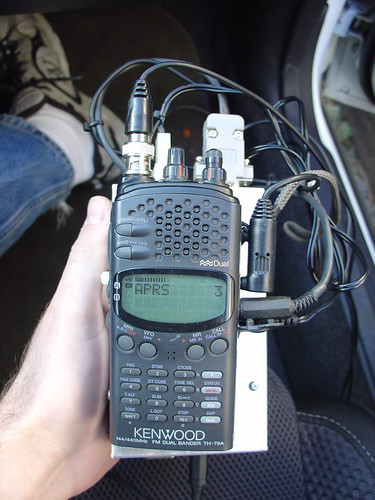
I made this APRS tracking box a couple years ago, so I’m a little fuzzy on the construction details, but it consists of the following parts:

  • A Trimble ACE III GPS module, originally used in a police car, $5 on eBay.
  • An external mag-mount powered antenna for the GPS that I found at HSC, also $5.
  • A Tinytrak3+ microcontroller-based APRS encoder and modem, $30
  • My old Kenwood TH-79A handheld 2 meter/144-148 MHz ham radio
  • A mag mount whip antenna for the HT, found at the electronics flea market.
  • An aluminum box, probably the most expensive part.
  • Some cables to glue all the pieces together, mostly salvaged from my junk box.

The APRS tracker acquires a GPS fix and the current GPS time.  Every so often (fully configurable), it transmits my position over the radio, where it is received by other APRS relay stations in the area.  Speed, direction, and altitude are also included with the position packet.  I connected a piezo buzzer to the TX signal so I hear a beep when the position is transmitted.  Within a few minutes, a point corresponding to the position shows up on the map at aprs.fi or in the findu database.

It’s really neat to play with, especially on long trips.  On a trip to Moab two years ago, my position was received by the APRS network even in areas with no cell coverage, which included most of Utah!

Note that to use the APRS system, you need to have an amateur radio license.  If you’ve ever been interested in amateur radio, this is a really good reason to get your license and start experimenting!

Cadsoft Eagle Support Forums

Twitter users, sorry for the link spam, but I thought this was valuable enough to stick up on the blog!

Anyone who uses Eagle will be happy to know that Stratford Digital is hosting a web forum version of the Cadsoft support newsgroups.  In their native format, the Cadsoft newsgroups require an NNTP newsreader – hats off to anyone who actually has one installed these days (I use MT-NewsWatcher on the Mac).

EAGLE Enterprise Toolkit Forums