Archive for February, 2009

100th post! Tony’s Wifi Radio Sketchup Model, Dorkbot Tonight

Wednesday, February 25th, 2009

100 Posts!

This is my 100th post to the blog.

When I started blogging in July of last year I wasn’t sure what I would post about or where all of this would go.  Eight months later, the blog has exceeded my expectations in many (and many unexpected) ways.  The major driving force behind this blog has always been my desire to share my projects and my passion for electronics with the world, in addition to (hopefully) inspiring some other people to do cool things with electronics as well.

My favorite post?  Definitely the Arduino-based AVR High Voltage Programmer.  I never expected such a simple circuit to help so many people.  There has been so much ongoing interest in this project that I am putting together an Arduino shield kit based on the original design.  The kit features a slick double-sided PCB and an integrated 5 to 12V step up converter so you don’t need an external 12V supply to use the programmer.  More details very soon!

Tony’s Wifi Radio Sketchup Model
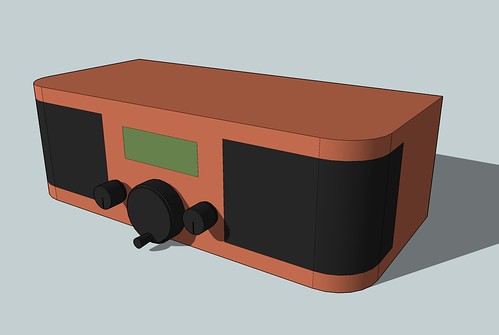
Wifi Radio Enclosure - Google Sketchup Model

Tony created this awesome Google Sketchup model of an enclosure for my Wifi Radio project.  After I made a very crude first draft, Tony took my design and turned it into something that is sort of modern, sort of retro.  Perfect!

Dorkbot Tonight

In other news, there is a Dorkbot SF meeting tonight at Parisoma at 7:30PM.  Arrive early to get a seat!  Details at dorkbot-sf.

Hal’s Lab: Standalone Weather Station

Monday, February 23rd, 2009

Hal created a neat project by taking parts of my Wifi Radio project and repurposing them to do something completely different.  His Standalone Weather Station changes the color of an LED based on the weather forecast for tomorrow.  If temperatures are trending warmer, the color changes towards red. Colder – blue.

His project is very well documented and includes code for both the ATmega168-based circuit that drives the LED using PWM and the shell script on the router that communicates with Weather Underground to get the forecast.

Nice work, Hal!

Hal’s Lab: Standalone Weather Station, Part 1

DIY Flexible Printed Circuits

Thursday, February 19th, 2009

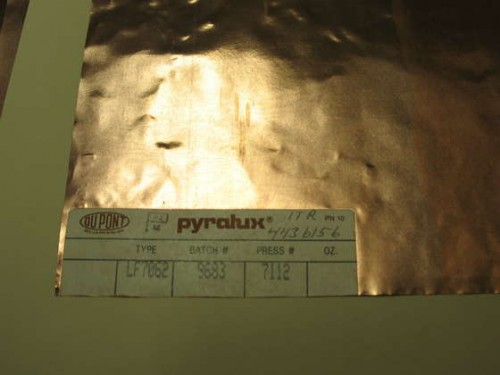
Pyralux material

Here’s a really cool Instructable about using a flexible copper-clad material called Pyralux to make flexible printed circuit boards.  You could make some really cool business cards with this stuff.

DIY Flexible Printed Circuits

(via makezine)

Come see me at NOTACON

Thursday, February 19th, 2009

naclogo_small

NOTACON is a conference dedicated to the intersection of technology, community, and creativity.  NOTACON takes place from April 16th-19th, at the Wyndham Cleveland at Playhouse Square in downtown Cleveland.

This will be my first trip to NOTACON, where I’ll be talking about Hacking the Asus WL-520gU Wireless Router.  My presentation will be largely based on what I learned from building my Wifi Radio project, including a bunch of things that never made it into the blog.  It should be a lot of fun and I am looking forward to meeting some cool people and exchanging ideas.

blockparty

This year, NOTACON also features Blockparty, North America’s longest currently running demoparty. If you have been around personal computers for the last 25 years, chances are you have been exposed to the demoscene.  This is your chance to see a real demo competition, in person, without traveling to Europe!

Last year, Jeri Ellsworth presented an amazing talk about creating demos with FPGAs.  Thanks to the NOTACON media archives you can watch a video of her talk.  Definitely check it out!

Advance registration is open, and as far as cons go these days, NOTACON is a pretty good bargain at $75 for basic registration.

Forrest Mims Engineer’s Mini-Notebooks

Tuesday, February 17th, 2009

Engineer's Mini-Notebook

I previously posted about Forrest M. Mims III’s Getting Started in Electronics, one of the best books out there for someone who wants a thorough, yet unintimidating introduction to electronic components and circuits.

From the mid-1980′s through the late 1990′s, Forrest Mims also published several mini-notebooks, each dedicated to a specific topic in electronics.  Each mini-notebook contains 50 pages of circuits, electronic concepts, and project ideas.

The complete set includes:

  • 555 Timer Circuits
  • Basic Semiconductor Circuits
  • Communications Projects
  • Digital Logic Circuits
  • Environmental Projects
  • Formulas, Tables, and Basic Circuits
  • Magnet and Sensor Projects
  • Op-amp IC Circuits
  • Optoelectronic Circuits
  • Schematic Symbols, Device Packages, Design and Testing
  • Science Projects
  • Sensor Projects
  • Solar Cell Projects

I had a few of the originals when I was growing up and wish I had kept more of them.  I specially remember reading the Optoelectronics Circuits Mini-Notebook in High School.  I attempted to build the optical communicator entirely with parts from Radio Shack, which was very difficult 15 years ago, and would be pretty much impossible today!

Updated/compiled versions of the notebooks are available on Forrest Mims’ website, but many of the originals can be found used for less than a few bucks each on amazon.com.


www.flickr.com
mightyohm More of mightyohm