Posts Tagged ‘Arduino’

The Amp Hour #43

Tuesday, May 17th, 2011

The Amp Hour #43 — Audacious Arduino Arguments

Our first four-way podcast!  Listen to me, Chris, Dave, and Jeremy chat about Arduino, high altitude balloons, hackerspaces in universities, the Google ADK, and the Maker Faire Bay Area.

Kudos to Skype for enabling us to actually pull this off!

HV Rescue Shield now works with the Arduino Mega

Wednesday, March 16th, 2011

HV Rescue Shield works with Arduino Mega!

Thanks to John, of the ATX Hackerspace, who loaned me his Arduino for testing, the HV Rescue Shield now works with the Arduino Mega.

I had to create new byte read/write functions for digital lines 0-7 because they are implemented very “differently” (and I don’t mean that in a good way) in the hardware for the Mega.  If you’re interested in how I did this, check out the new version 2.12 Arduino sketch and the new mega_data_read and mega_data_write functions.

To use the HV Rescue Shield with the Arduino, first download the revised sketch here.  Set the MEGA #define to 1 and compile/upload the sketch to your board.  Make sure you have the Arduino Mega selected in the Arduino Board menu, or the sketch won’t compile.

The Mega has more pin headers than the Rescue Shield, so be sure to install the shield all the way to the left, as shown here:

HV Rescue Shield alignment on the Arduino Mega

If you experience any problems with the HV Rescue Shield and the Arduino Mega, please report them in the support forum.

New Product: HV Rescue Shield 2.0

Monday, December 13th, 2010

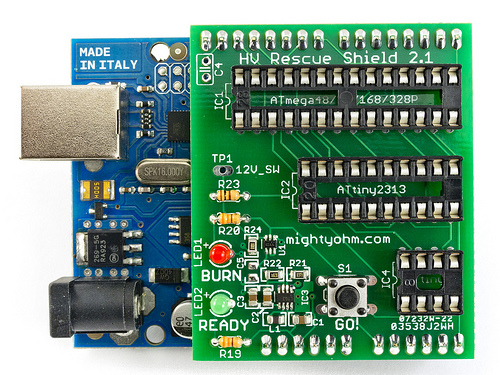
HV Rescue Shield 2.x

The HV Rescue Shield 2.0 is a high voltage parallel mode fuse programmer for Atmel AVR microcontrollers.

It currently supports a wide variety of AVR chips, including the 28-pin ATmega48/88/168/328 series, the 20-pin ATtiny2313, and many 8-pin ATtiny devices (such as the ATtiny25/45/85 and ATtiny13A).  A list of supported devices is in progress, but the Rescue Shield supports many more devices than those listed on the wiki.

The HV Rescue Shield 2.0 is in stock and ready to ship today!  Scroll down to place an order.

New in release 2.0:

  • Support for 8-pin ATtiny devices that use High Voltage Serial Programming (HVSP) mode!
  • Mode selection at startup so you don’t have to recompile the Arduino sketch to change parts.
  • More reliable HFUSE burning on all HVPP targets.
  • Numerous minor bug fixes and speed improvements to the code.
  • Reduced price, kit is now only $19.95 (was $24.95).   This means the kit is lower cost, but with more supported parts!

Requirements:

  • A working Arduino (tested with Arduino Uno, Duemilanove and Arduino NG)
  • A computer with USB and the Arduino IDE installed (tested with Arduino 0021)
  • A soldering iron and basic electronics assembly skills

What you get:

  • A high quality printed circuit board with the DC-DC converter preassembled, as shown below.
  • All other components needed to build the kit
  • An Arduino sketch, assembly instructions, Eagle schematics and layout files.

Here is a snapshot of the components included with the kit.

parts

How to Order:

Visit the HV Rescue Shield 2.x product page to place an order.

HV Rescue Shield 2.0 update

Thursday, December 2nd, 2010

HV Rescue Shield 2.0

Version 2.0 of the HV Rescue Shield (I decided to drop the ‘AVR’ from the name) will add support for high voltage serial programming (HVSP) and 8-pin parts like the ATtiny13A.

Boards are due back next week, components are on order, but there is still code to write.

Back to work!

Arduino Oops!

Monday, October 4th, 2010

Closeup side view under the microscope

That’s a closeup of resistor R1 on my new Arduino Uno board.  See how the left terminal isn’t touching the solder bump on the land pad?  That’s not good.

Surprisingly, my Arduino seems to work just fine with one side of the resistor open.  Arduino, don’t let the cost reduction guys see this one, or they’ll eliminate it in the next rev!

More photos of the tombstoned resistor on my Arduino Uno.

The Arduino team has responded to other claims of manufacturing defects (most of which seem fairly trivial) in their blog post “One bad Arduino doesn’t spoil the barrel“. I have already contacted my reseller and will do everything possible to help Arduino improve their manufacturing process and quality control.


www.flickr.com
mightyohm More of mightyohm