Getting Started in Electronics , by Forrest M. Mims, III. is a spectacular introduction to the world of electronics. This book is not new – the truth is that it has changed little since it’s first release in 1983. Despite this, twenty-five years later, there is really nothing else like it. This book is suitable for beginners of any age yet it comprehensively describes the technical theory and practical use of electronic devices like resistors, capacitors, inductors, diodes, transistors, FETs (including the now-rare JFET), and LEDs, as well as circuits like amplifiers, oscillators, and logic gates. There is even a graphical introduction to device physics (semiconductor materials, doping, electrons and holes) and semiconductor fabrication! This is kind of stuff they teach third-year students in university ECE classes, written in a way that is understandable to a child in third grade!
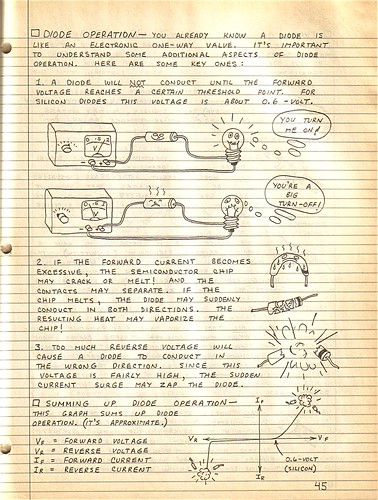
The entire book is formatted like an engineering notebook with handwritten notes on every page. The illustrations are fun and make the book friendly and accessible. Here is an excerpt from the chapter on diodes:
My father gave me this book when I was six or seven years old along with a 25 watt soldering iron from Radio Shack. I am convinced that this book, together with a Science Fair 160-in-ONE kit, is what caused me to pursue a career in Electrical Engineering. I still enjoy leafing through its pages and proving to myself that I can understand how each circuit works.
Forrest Mims himself is an interesting individual and has led a prolific career as a writer and amateur scientist. He is an active member of the Society for Amateur Scientists (SAS) and edits the Citizen Scientist.
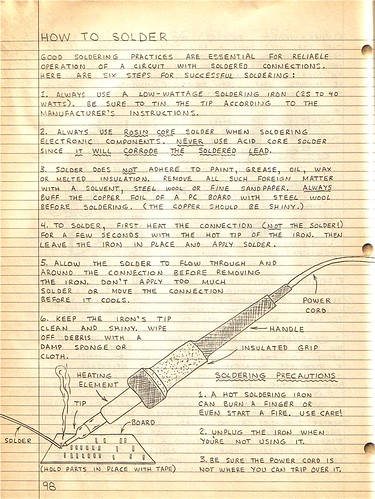
The book even includes a handy guide to help you learn How to Solder!
Thankfully, it turns out that this fantastic book is still in print. The groovy green cover is gone (a mistake, in my opinion), but the contents have not changed. This is fantastic news for anyone interested in learning about electronics. These also make great Christmas presents – I bought one for my brother last year and he loved it!
In my opinion, this is probably the greatest introductory book about electronics ever written. I’d be curious to hear if anyone has any other favorites – leave a comment if you do!
Happy 25th, Getting Started in Electronics!


 digital HD camcorder with very impressive low light abilities.