Tag Archives: featured

A spotter’s guide to the SBM-20 Geiger counter tube

SBM-20 and friends
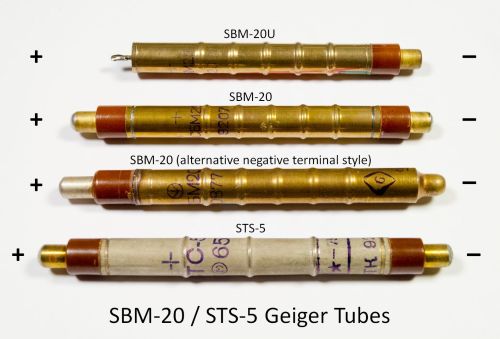
click to enlarge

The picture above shows a variety of Geiger tubes that are commonly sold under the name “SBM-20”. This post is an attempt to clear up some of the confusion around these tubes and to share some information about the different tube styles I have encountered in the wild since I first started selling Geiger Counter kits in 2011.

This is my spotter’s guide to the SBM-20 Geiger counter tube.

SBM-20

This is the quintessential Soviet Geiger Counter tube. 400V operating voltage. 105mm overall length. Gold (brass?) color. Symmetric end caps. Positive terminal is usually marked ‘+’, but if not, it’s the end closest to the CBM-20 marking. Date codes are always four digit, but I have seen both MMYY and YYMM (assuming I am interpreting the numbers correctly). Year of manufacture varies widely but most are 1970s – 1990s.

SBM-20U

Very common alternate version of the SBM-20. Shorter 95mm overall length. Positive terminal is exposed rod with no end cap. Soldering to this terminal can be a challenge as the plating is usually quite oxidized and the underlying metal is steel.  I’ve also seen the internal glass seals fail after soldering. These are often sold as SBM-20 tubes, and unscrupulous eBay sellers will sell the SBM-20/SBM-20U interchangeably.

SBM-20 (alternative negative terminal style)

Slightly longer positive terminal. 105mm overall length. Negative terminal is formed from the tube body (cost saving design?). Tubes I have seen are marked ’77’, presumably date code for 1977. Rare.

STS-5 / CTC-5

Older version of the SBM-20. Slightly longer overall length, approx. 110mm. Silver color. Positive terminal is marked + and closest to the CTC-5 marking. Date codes I have seen are mid-1960s through 1970s. I haven’t confirmed this, but I suspect date code is roman numeral month followed by arabic numeral year, eg. VIII 65. Aside from longer overall length, properties and performance are very similar to SBM-20. Less common than SBM-20, presumably because they are older and were not manufactured in great numbers across as many years. Sometimes sold under the name SBM-20.  They are generally interchangeable with “real” SBM-20 tubes, but given that they are significantly older, failure rate might be higher (unconfirmed).

Summary

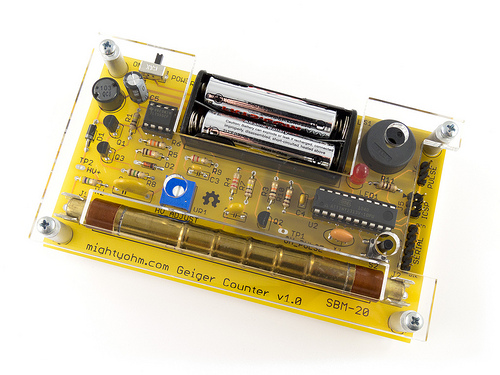
My Geiger Counter kit will accommodate the STS-5 and all of the SBM-20 variants shown. The SBM-20U requires a short jumper wire to connect the positive terminal to the PCB. I recommend using an alligator clip or wrapping a wire around the terminal to avoid compromising the glass to metal seal with the heat of the solder.
Feed your Geiger: Cheap and Readily Available Radioactive Test Sources

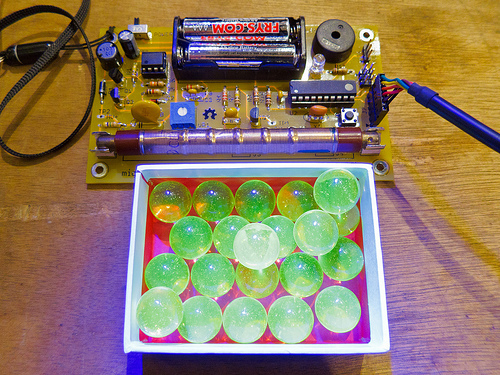
Want to check if your freshly-assembled MightyOhm Geiger Counter kit is working? You’ll need something radioactive! But why pay over $100 for a professional test source when there are plenty of cheap and readily available radioactive items available at your local antique store or online?

Continue reading Feed your Geiger: Cheap and Readily Available Radioactive Test Sources

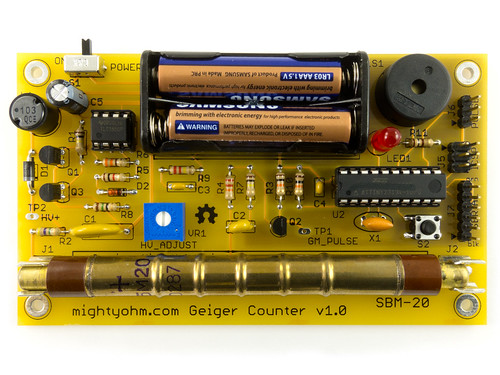
Introducing the MightyOhm Geiger Counter Kit

Geiger Counter Kit - Finished

Look!  A new kit!

I admit that I’ve been working on this one for a while.  Sorry for the lack of updates, but I have been far too busy doing everything last minute and fixing bugs to post here!

I designed this Geiger Counter kit specifically so I could give a workshop at Chaos Communication Camp 2011.  I just couldn’t fly halfway around the world only to show up at a hacker conference empty-handed!

My workshops are tentatively scheduled for Thursday and Saturday.  I’m not bringing very many kits, so if you’re coming to Camp, sign up early!

More information about the kit is here.  I’ll be adding more documentation over the next couple weeks.

Hopefully I’ll also be showing off this kit next month at the OSHW Summit and the NY Maker Faire.

Announcing the “Soldering is Easy” Complete Comic Book!

Do you want to learn how to solder?  Do you want to make really cool things?  Do you want to teach other people how to solder (and make cool things too)?

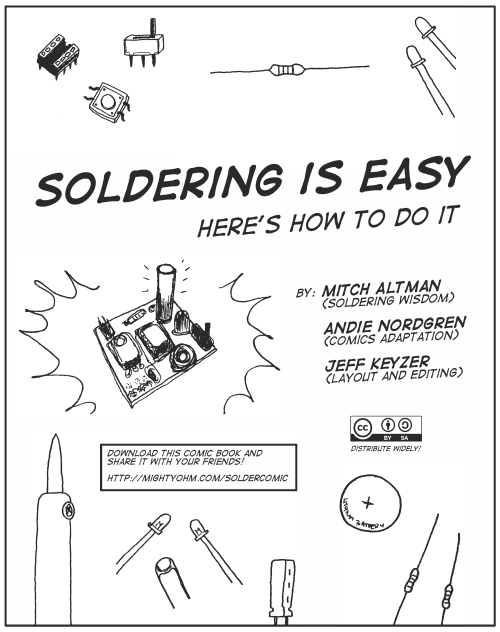
I’m happy to announce the release of Soldering is Easy, a comic book that will teach anyone the basics of soldering.

This seven page comic book explains in detail and with pictures how to make a good solder connection.  It also teaches you all the other bits and pieces of knowledge  that you need to successfully solder together an electronic kit, even if you’ve never soldered before!

I worked with Mitch Altman (@maltman23) and Andie Nordgren to create this revised and extended version of the wildly popular one page handout that Mitch and Andie created in 2010.

The comic (and lots more cool stuff!) will be included in a book that Mitch and I are writing about How to Make Cool Things with Microcontrollers (For People Who Know Nothing). It will be published by No Starch Press.

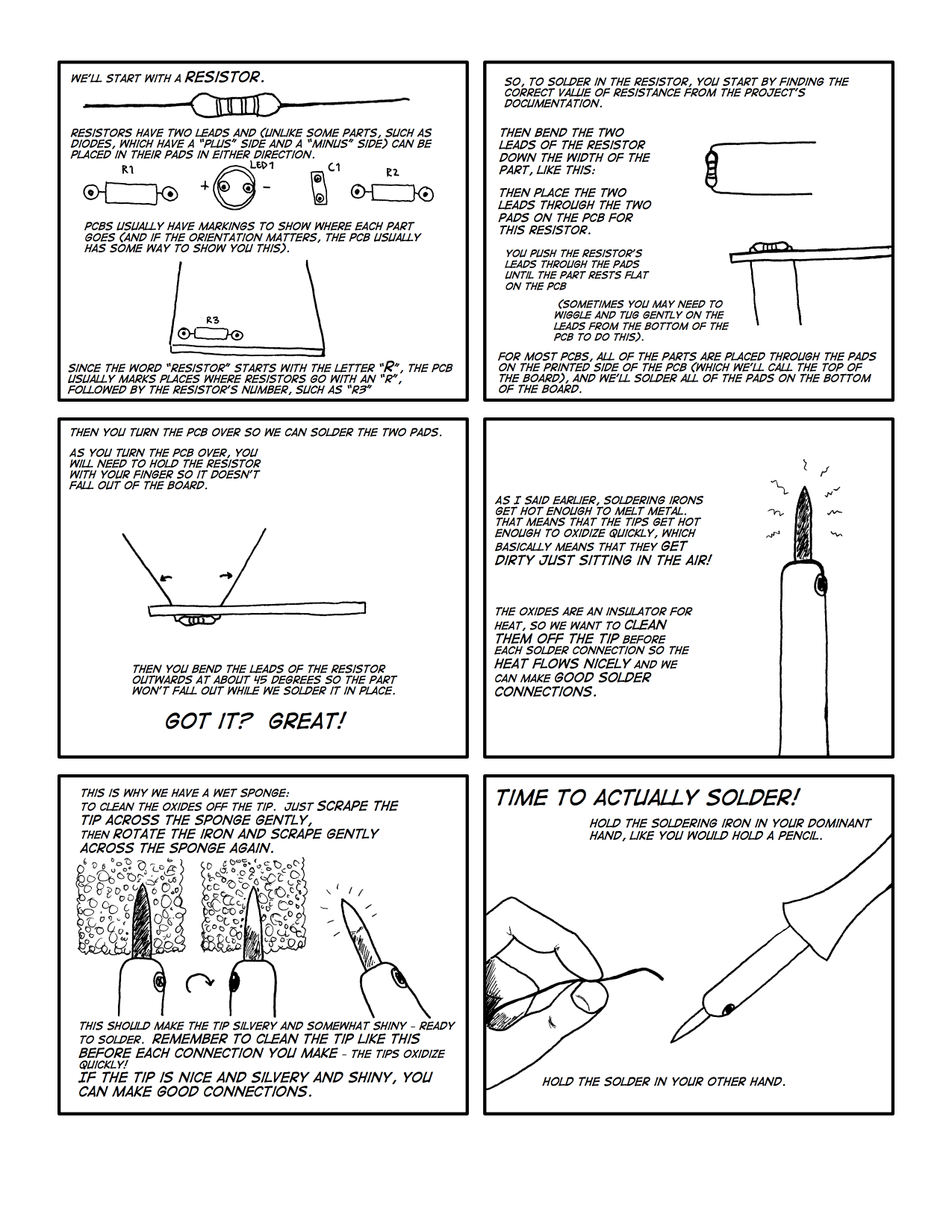
Here’s a sample page (click for a bigger version):

As of 2015 the comic book has been translated into 21 other languages! A huge thanks to everyone who sent in translations and is helping us spread our message around the world! We would love for people to translate the comic book into more languages! If you create a translation, please post a comment here and I’ll link to it! If you’re looking for help with a translation, you can try posting in the forums.

The comic is released under a Creative Commons license (Attribution-ShareAlike), so you are free to teach with it, color it, modify it, share it with your friends, translate it, and basically do whatever you like with it!

English:

The complete comic book is available for download here:

“Soldering is Easy” Comic Book (PDF)

We also have some other versions of the comic available:

Translations:

PDF File Language Translators
Arabic Ahmed Mo’ni
Azerbaijani Orkhan Amiraslan
焊接是容易的
简体中文版
Chinese (Simplified)
XinCheJian
焊接是容易的
繁体中文版
Chinese (Traditional)
XinCheJian
Lemiti je lako
Hrvatski
Croatian
Ivan Matacic
PÁJENÍ JE JEDNODUCHÉ
Český
Czech
Jindra Fučík
Det Er Nemt At Lodde
Dansk
Danish
Jesper Haffgaard
Iedereen Kan Solderen
Nederlands
Dutch
Ivo van den Maagdenberg
Alt. translation by Deeeep
Jootmine On Imelihtne
Eesti
Estonian
Markus Järve
Souder c’est Facile!
Français
French (updated May 2015)
Snootlab
Löten ist einfach!
Deutsch
German
Alexander Bodora
Richard Meinsen
Οδηγός Για Εύκολη Συγκόλληση
Ελληνικά
Greek
F.N.
Forrasztani Egyszerű
Magyar
Hungarian
dnet
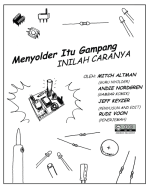
Menyolder Itu Gampang
Bahasa Indonésia
Indonesian
Rudi Voon
Saldare E’ Semplice
Italiano
Italian

Michele Maffucci
ハンダ付けなんて簡単だ!
日本語
Japanese
Yoshi
Det Er Enkelt A Lodde
Norske
Norwegian

Henrik Sandaker Palm
Lutowanie Jest Proste
Polski
Polish

Mark
Solder É Fácil
Português
Portuguese (Brasilian)
Radamés Ajna
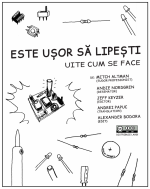
Este Ușor Să Lipeşti
Română
Romanian
Andrei C. Papuc
Alexander Bodora
ПАЯТЬ ПРОСТО
Русский
Russian (new updated and colorized version!)
Atarity
Alternate black and white version
Solder es Fácil
(Version 1)

Español
Spanish
SGTECH
2nd translation by juani_c
Att Löda Är Lätt!
Svensk
Swedish
Christopher Eriksson
Lehím Yapmak Kolaydir
Türkçe
Turkish
Uğur Arıcı
Özcan Oğuz
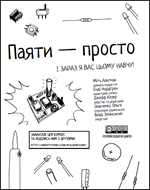
Паяти — просто
українська
Ukranian
Ukranian Maker Association

Special thanks to Alexander Bodora for creating the original version of this table!

And really, soldering is easy (and fun!).  Learn how to solder and teach your friends!

New Product: HV Rescue Shield 2.0

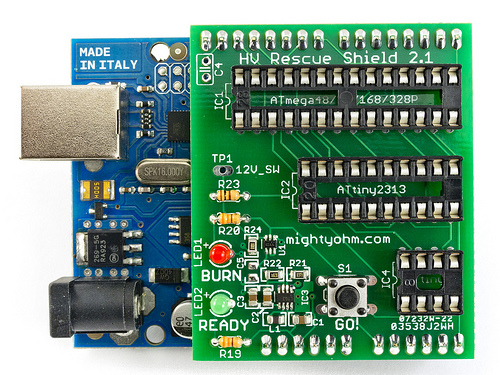
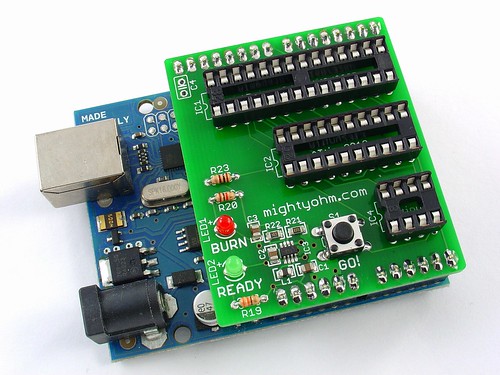
HV Rescue Shield 2.x

The HV Rescue Shield 2.0 is a high voltage parallel mode fuse programmer for Atmel AVR microcontrollers.

It currently supports a wide variety of AVR chips, including the 28-pin ATmega48/88/168/328 series, the 20-pin ATtiny2313, and many 8-pin ATtiny devices (such as the ATtiny25/45/85 and ATtiny13A).  A list of supported devices is in progress, but the Rescue Shield supports many more devices than those listed on the wiki.

The HV Rescue Shield 2.0 is in stock and ready to ship today!  Scroll down to place an order.

New in release 2.0:

  • Support for 8-pin ATtiny devices that use High Voltage Serial Programming (HVSP) mode!
  • Mode selection at startup so you don’t have to recompile the Arduino sketch to change parts.
  • More reliable HFUSE burning on all HVPP targets.
  • Numerous minor bug fixes and speed improvements to the code.
  • Reduced price, kit is now only $19.95 (was $24.95).   This means the kit is lower cost, but with more supported parts!

Requirements:

  • A working Arduino (tested with Arduino Uno, Duemilanove and Arduino NG)
  • A computer with USB and the Arduino IDE installed (tested with Arduino 0021)
  • A soldering iron and basic electronics assembly skills

What you get:

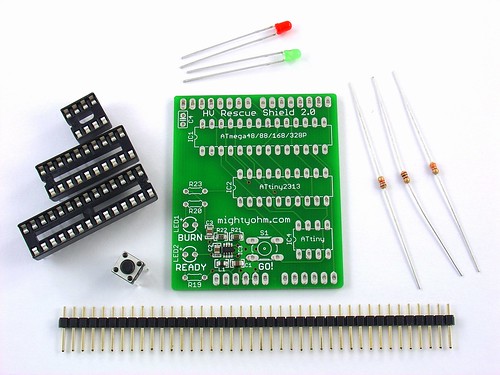
  • A high quality printed circuit board with the DC-DC converter preassembled, as shown below.
  • All other components needed to build the kit
  • An Arduino sketch, assembly instructions, Eagle schematics and layout files.

Here is a snapshot of the components included with the kit.

parts

How to Order:

Visit the HV Rescue Shield 2.x product page to place an order.