Neat art installation in Helsinki displays laser images on the smoke plume of a power plant.
Maybe we could convince them to make the world’s largest oscilloscope now that they’re done?

Neat art installation in Helsinki displays laser images on the smoke plume of a power plant.
Maybe we could convince them to make the world’s largest oscilloscope now that they’re done?
In preparation for my Arduino-based AVR HV Programmer boards coming back, I decided to step up my home lab surface mount soldering capabilities.
Step one was to find a cheap stereo zoom microscope on ebay, with 7-32X magnification, perfect for working on surface mount devices. One of my biggest frustrations in the past is that with a cheap magnifying ring light, I can’t actually see what I’m working on – not any more! I’ll post some photos of the microscope when it comes.
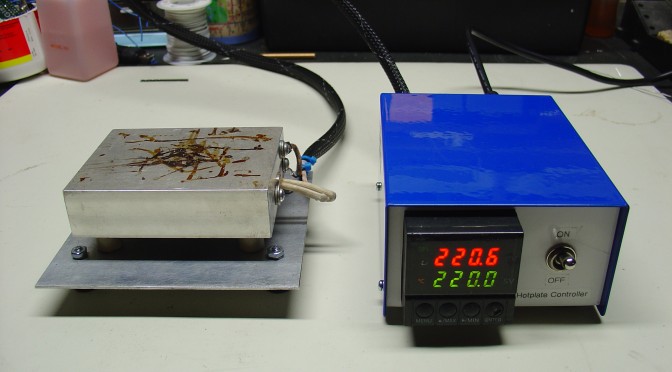
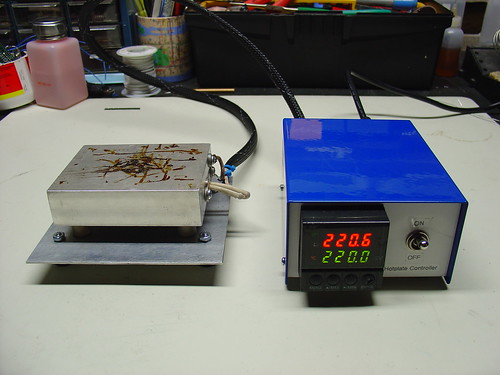
Step two was to build a soldering hotplate. I like using a hotplate for surface mount soldering because you can actually watch the board as the solder paste reflows, and manually add/remove/nudge components around with a set of tweezers. This is great for engineering work where you may still be making component changes and other tweaks to the board. Mass production is probably best left to a reflow (aka toaster) oven.
I posted a few photos of the hotplate on flickr, which ended up on Hackaday.
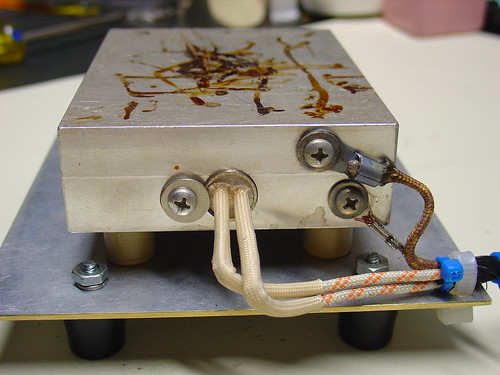
The heater is a 1/2″ 500W, 120VAC cartridge heater I bought from McMaster-Carr for about $25. The hotplate itself is a 3x4x1″ chunk of aluminum that I machined with a carefully sized hole just below the center for the heater to slip into, as shown. A type-K thermocouple (top right) measures the temperature and provides a signal to the controller. Ceramic standoffs insulate the hotplate from the bottom aluminum baseplate. For safety, there is also a ground strap, shown on the bottom right.
This the second PID controlled project I have done, the first was my PID Controlled Solder Paste Fridge.
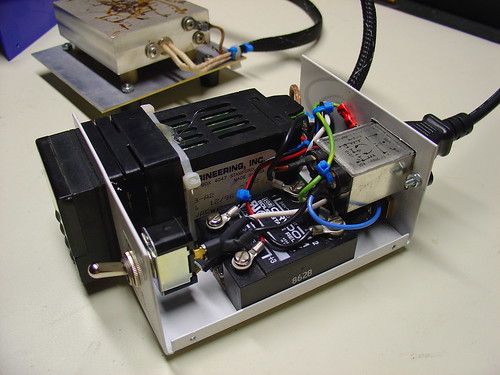
The controller box contains an Omega CN77000 series PID controller and an IR/Crydom 240V 40A (overkill!) D2440 Solid State Relay (SSR), along with a power switch, fuse, and power connector. The PID controller and solid state relay were both found at a now-defunct Silicon Valley surplus store for a few bucks each. A 3′ umbilical cable connects the controller to the hotplate.
60/40 leaded solder reflows at about 185C, and lead-free solder is around 200-230C depending on the alloy. (Wikipedia has a good list of reflow temperatures.) The hotplate can easily reach these within a minute or two from room temperature and could get much hotter if necessary.
It can also be used to cure epoxy and perform any other tasks that require a precisely controlled heater – this could be the world’s most overengineered coffee warmer, if not for the dangers of lead poisioning.
Update: I just posted some more information about the microscope.
Two big meetings in the SF art/tech/DIY/make scene are happening tonight:
Make:SF Meeting @ Instructables HQ 6:30PM
Dorkbot @ Monkeybrains 7:30PM
Both meetings are in the same building/complex so it should be quite possible to go to both (at least that’s my plan).
Have you ever wondered why standard 5% resistors have strange values, like 330 and 470 Ohms, instead of nice round numbers like 300 or 500 Ohms?
It turns out that standard resistor values form a preferred number series defined by the EIA. 5% values are part of a standard called E24. The standard is based on a geometric series – each value is approximately 1.1 times the previous one in the set.
This scheme ensures that the resistance values are separated by an amount approximately equal to twice their tolerance. Since a 5% tolerance resistor could actually be plus or minus 5% of the nominal value, the E24 range spaces the values by 10%. That way, where the tolerance range of one value leaves off, the next higher value picks up, with the smallest possible overlap or gaps in resistance.
For example, 330 Ohms + 5% = 347 Ohms. The next highest E24 value is 360 ohms, and 360 Ohms – 5% = 342 Ohms. There is a small overlap of 5 ohms because the values don’t follow the geometric series exactly (due to rounding to the nearest 10 Ohms). Spacing resistances significantly closer than their tolerance range would be silly – a 330 Ohm resistor could in reality be larger than a resistor marked 335 Ohms if both resistors had a 5% tolerance.
Here is a chart of the E24 resistor values between 100 Ohms and 1k:

As you can see in the chart, E24 values are nicely spaced between 100 and 1k Ohms. Below 100 Ohms or above 1k, the series simply repeats. The name E24 comes from the fact that there are 24 values per decade of resistance.
Other EIA standards define the values for other tolerance ranges. Here is E96, commonly used with 1% resistors:
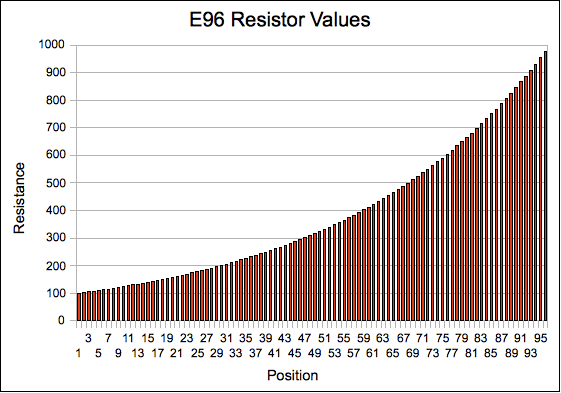
In this case, each value is 2% larger than the previous value, yielding 96 values per decade!
It’s nice to know the range of possible resistor values when you are designing circuits. This quickly answers the question of whether you can use 573.25 Ohms in your circuit. (No. Well, not easily.) There are lots of EIA tables online, including some that are colorful and some that can be printed and stuck on your wall.
The EIA values are also part of IEC standard 60063, so you may see them referred to as EIA or IEC resistance values, just to make things more confusing, but the values are the same.
Dorkbot-SF is holding their next meeting at Monkeybrains next Tuesday, 1/13, at 7:30PM.
Here’s a summary of the talks for next week, hope to see you there!
Joe Grand – The Projects of Prototype This
Designing and building projects is hard. Designing and building projects of things that have never been done before is harder. Designing and building projects of things that have never been done before with the financial and time constraints of television is verging on ridiculous.
For 18 months, I was a co-host of Prototype This on Discovery Channel, an engineering entertainment program that followed the real-life design process of a unique prototype every episode. Comprised of an electrical engineer (that’s me), a roboticist, a material scientist, and special effects guy, we had the major bases covered and would often join forces with outside resources. We filmed thirteen episodes in very challenging conditions and that single season has almost finished airing.
In this mostly visual presentation, I’ll go through design details and show never-before-seen pictures and videos related to some of my favorite episodes, including the Traffic-Busting Truck, Fire Fighter PyroPack, and Virtual Sea Adventure, each of which had to be designed and built in a matter of weeks.
Joe Grand (aka Kingpin) is an electrical engineer, hardware hacker, and president of Grand Idea Studio, Inc., where he specializes in the invention, design, and licensing of consumer products, video game accessories, and modules for electronics hobbyists. He also spent many years as part of hacker collective L0pht Heavy Industries in Boston finding security flaws in hardware devices and educating engineers on how to increase security of their designs. He.s written a few books, holds a few patents, and is also the sole proprietor of Kingpin Empire, a project that gives back to the technology and health communities through charitable donations. His contributions to Prototype This can be found on his site at: www.grandideastudio.com/prototype-this.
http://www.grandideastudio.com
http://www.kingpinempire.comMichael Ang – Gigapixels: Practice and Aesthetics
Creating images with gigapixel (1 billion pixel) resolution is now within the reach of anyone with a digital camera and computer. Picture taking robots such as the GigaPan can automatically take many overlapping pictures of a given scene. The individual pictures can be automatically stitched together to create a large final image. What are the aesthetics of this newly accessible medium? How does stitching together many small images differ from taking one very large one?
Michael (aka “Mang”) first used the GigaPan in the summer of 2007, when he took a prototype unit from Moffett Field to Alaska by pickup truck. This talk presents some of his work with robotically assisted photography. Practical aspects of creating large panoramas will be presented as well less straightforward uses of the technology.
Mang holds a BASc in Computer Engineering from the University of Waterloo in Canada and a Master’s Degree from NYU’s Interactive Telecommunications program. His interests include the intersection of technology, art and physical experience.
http://www.michaelang.com
Gigapan.orgPaul Cesewski (aka Paul da Plumber)- Fun is the Universal Language
Explore a carnival of interactive machines. People powered contraptions delight and amuse. New and used materials are used in a kind of contemporary alchemy. The re-animation of yesterdays dreams.
Paul’s work focuses on interactive sculptures. He has worked in general contracting work, fabrication, and high-end construction for the last twenty years and has built many commissioned public art projects in the context of his own work, on collaborations, and as part of San Francisco’s Bike Rodeo.
Some of Paul’s installations include: Bicycle Ferris Wheel and Bike to the Moon, Cyclefuge, Lotus Land, etc.