Test Equipment Pr0n: The HP 3312A

A few weeks ago, I purchased an HP 3312A 12MHz function generator for the lab.  After living without a decent signal source for years, I figured that it would bepo handy to have a good general purpose function generator around.  A quick visit to eBay and a few clicks later, one was on the way.

Unfortunately, when I first powered it up, the output was clamped to one supply rail and the sync output was giving me a much-too-large, out of spec voltage swing.  D’oh!

The generator was sold as-is (like most test equipment on eBay), so I decided to take a crack at fixing it myself.  Armed with a barely intelligible, poorly scanned-faxed-photocopied copy of the 3312A service manual that I downloaded from Agilent’s website, I loosened two captive screws and slid the top and bottom covers off the unit.

What I found inside really blew me away.  What follows are some snapshots of the unit.

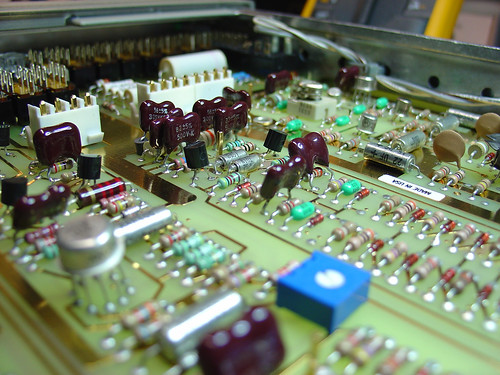
The 3312A is the most elegantly designed and well-preserved piece of electronic test equipment I that have ever owned.  The circuit boards, which look brand new, use entirely two-layer  through-hole construction and are laid out with generous component spacing and helpful silkscreen labels.  There is no inter-board wiring to prevent quick removal of any of the PCBs; all of the wiring harnesses use straightforward connectors.  Connections between the top and bottom PCBs are via clever gold plated removable posts that extend through the center panel of the instrument chassis.  The chassis itself, which is cast aluminum, is light but sturdy.  Every aspect of the instrument design appears to have been carefully thought out and is perfectly executed.

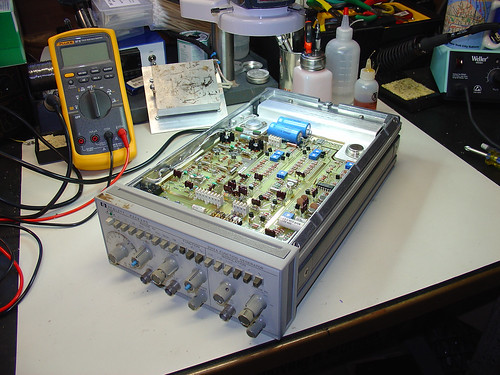
Here’s the 3312A on the bench, ready for some serious troubleshooting action:
HP 3312A Repairs

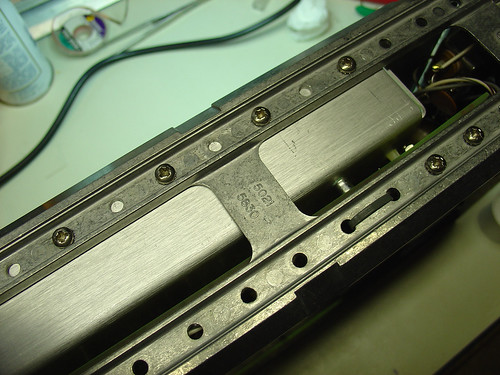
The aforementioned aluminum chassis.  Very nice!
HP 3312A Repairs

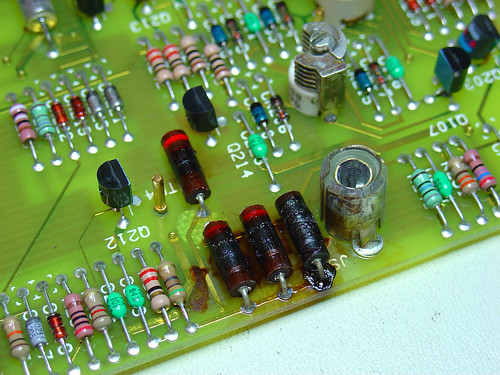
When I flipped the generator over, I immediately noticed a problem.  Here are the remains of four 200 ohm, 1W carbon resistors, burnt to a crisp:
HP 3312A Repairs

These resistors provide an internal 50 ohm termination for the sync output, and explain why the sync voltage swing was out of spec.  A quick trip to Jameco for some new 200 ohm power resistors and the sync problem was fixed.

The broken main generator output took some more serious troubleshooting.  One of the emitter follower transistors that drives the push-pull output driver was burning hot to the touch and a good candidate for replacement.  An hour of troubleshooting with the diode test function of my Fluke 87V identified one of the push-pull transistors had failed as well.  This is the device that had failed short and was clamping the output voltage to the -15V supply rail.

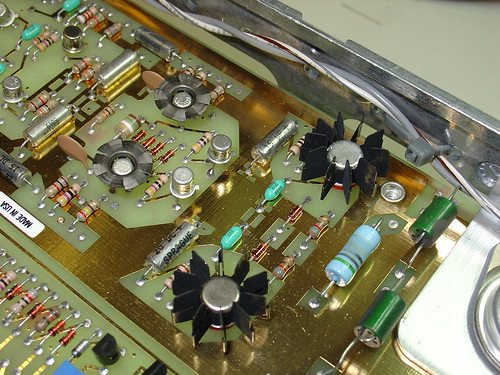
The final push-pull drivers are shown here; they are the two devices with the largest heatsinks.  The emitter followers are the two metal can transistors just to the left.
HP 3312A Repairs

I was able to find suitable replacements for the failed transistors at Jameco.  Neither of the original devices were still available but I was able to find some devices that were “close enough” by examining a few datasheets and cross reference guides.  With the faulty output devices replaced, the generator powered up and was good as new!

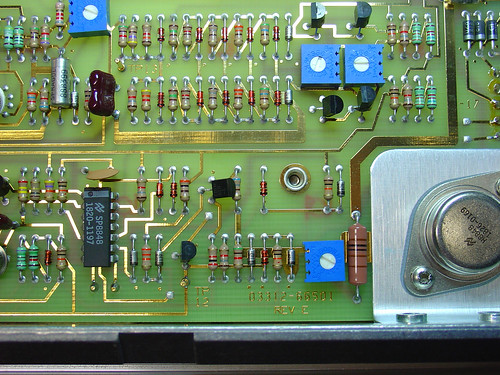
Here’s another couple shots of the main PCB.  Gorgeous gold-plated traces and component layout, and some pretty components too:
HP 3312A Repairs

HP 3312A Repairs

Here’s a shot of the inside of the generator with the top (modulator) PCB removed so you can see the header posts that connect the top and bottom PCBs.  The center aluminum plate that holds the pins in place is also removable.  This allows for rework of components on the bottom (main) PCB without disassembling the entire instrument.  Cool!
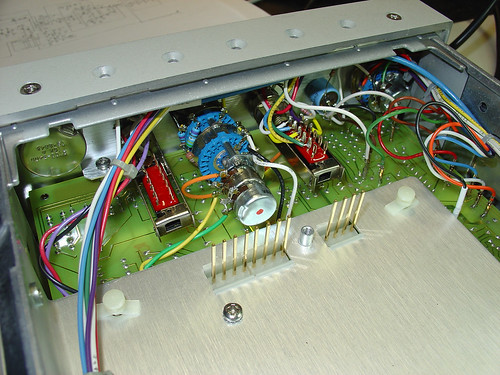
HP 3312A Repairs

Want to see more?  Check out the 3312A repairs album on flickr!
Dorkbot-SF @ Noisebridge Tonight

when:    nov 18 2009 wed 7:30pm
where:     noisebridge
2169 mission, SF, 3rd floor

speakers:

anselm hook – augmentia: scratching the surface of augmented reality
http://hook.org

shelly farnham – steve the robot h.e.ai.d.: a large scale generative
music and laser play space
http://shellyfarnham.com

david gessel – stalking slanderizing trolls
http://blackrosetech.com

gian pablo villamil – 360 degree panoramic video without the megabucks
http://villamil.org/?p=621

I’m planning to head over around 7pm and will hopefully see some mightyohm.com readers and dorkbot regulars there tonight!

EEVblog – The Electrical Engineering Video Blog Podcast

David L. Jones, maker of, among many other things, the awesome uWatch, is producing a really cool Electrical Engineering-themed video blog/podcast called ‘EEVblog‘.  I don’t why it took me this long to realize what an informative and hilarious video podcast this is, but a couple recent episodes really sucked me in.  I am now a huge fan.

David’s blog actually sprang to life in April of this year, so if you want to watch all of the episodes you have some catching up to do.  However, some of the most hilarious episodes are also the most recent.  For example, here is David’s very honest review of the Microchip PICkit 3, a development tool for Microchip PIC microcontrollers:

And here is Microchip’s equally hilarious response:

David’s blog has covered a lot of other cool topics, such as exploding capacitors, equipment teardowns, and microcontroller datasheets.  Check EEVblog out!

Agilent firmware update confirms Rigol connection

Last week, Agilent released a firmware update for their 1000 series oscilloscopes.  The 1000 series, Agilent’s lowest end line, is a family of powerful yet reasonably priced digital storage oscilloscopes that includes my DSO1014A.

When I downloaded the firmware update and copied it to a USB stick for transfer to the scope, I noticed that the suffix of the file was .RGL.  This reminded me of some rumors I heard a few months back about how Agilent’s low-end scopes are actually manufactured by Rigol Technologies.  Rigol makes some very interesting low cost scopes, including the DS1052E, which was reviewed favorably on EEVblog earlier this year.

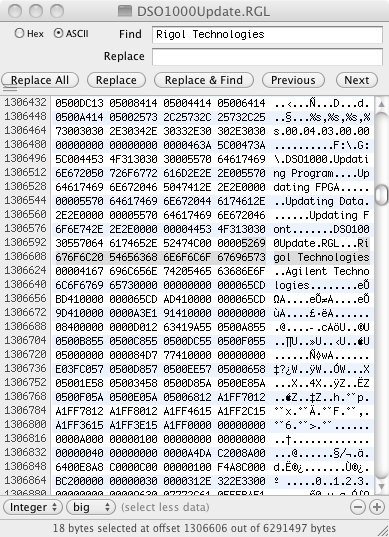
I opened the .RGL file in a hex editor, and found this:

Rigol Technologies

The highlighted string, “Rigol Technologies“, confirms the Rigol connection.

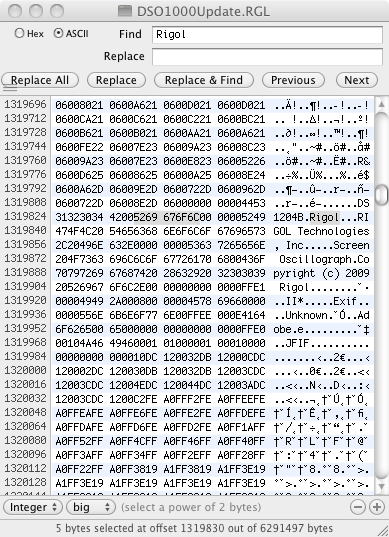
Later in the same file, Rigol shows up again:

RIGOL

Clearly Rigol is involved with (and probably wrote) the firmware for Agilent scopes.

Interesting also is that the string “DS1204B” shows up in the file.  The DS1204B is a 200MHz Rigol model that looks pretty similar to my scope, and the screenshots are a perfect match too.

I’m not implying that this is a bad thing, just interesting.  If Agilent needs to outsource the design and/or manufacturing of their low end scopes in order to provide an inexpensive entry-level scope with the Agilent badge on it, so be it.  What I haven’t done is actually opened the scope to see if Rigol’s name appears on the hardware as well.  Has anyone voided their warranty to investigate?

One more note, I found the DS1204B for $1895, over $500 less than the retail price of the corresponding Agilent DSO1024A.  This might make the Rigol an attractive alternative if having the Agilent name on your equipment isn’t important to you.  Note that I have not made any effort to go through all the specs for each scope and look for differences.  I wouldn’t be surprised if Agilent added their secret sauce to the DSO1000’s to tweak the performance.  It would certainly be interesting to see a side by side comparison of both scopes.

Join the resistance.