Archive for July, 2009

Tony’s Diamond Chop Saw (Part 1)

Friday, July 31st, 2009
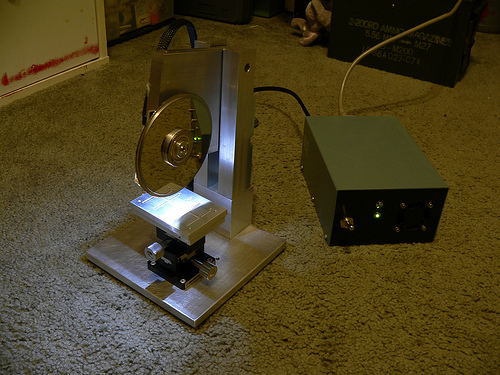
dicer_small
This is guest blogger Tony reporting on my latest project, a very small, precise circular chop saw.  Why would anyone want to build such a saw you might ask?  Well, to make parts for another project of course!

So here’s the background….I’m building a ham radio that operates at 47 GHz.  At such a high frequency there are very few components that can be soldered on to circuit boards, let alone components that even come packaged!  The easiest way to build a high performance radio at these frequencies is to use MMICs (Monolithic Microwave Integrated Circuits).   These are really just fancy, yet fairly simple circuits made from exotic materials, most commonly Gallium Arsenide (GaAs) instead of the usual Silicon used for normal chips.  Before MMICs were in widespread use, individual transistors had to be used, requiring delicate and hard to make external matching elements.  MMICs are like nice little 50 ohm building blocks.  Low Noise Amplifiers (LNAs), mixers, Power Amplifiers (PAs), phase shifters, etc. etc. are all available in this form.  Trouble is that you have to connect these pieces up to make a functional radio (or at least the microwave portion of it).
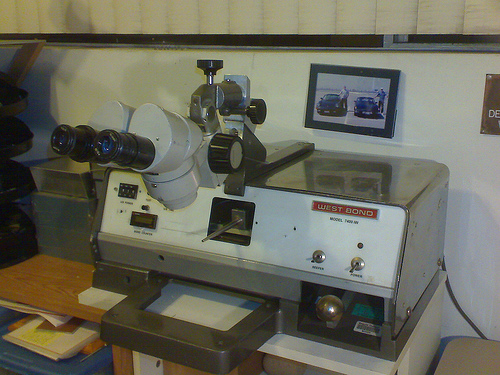
My WestBond wedge bonder

My WestBond wedge bonder

Wire bonding is the usual method for connection and is really just a method of welding a wire (or ribbon) from one chip to the next.  It turns out that you actually need space in between the chips, for thermal reasons, RF reasons, and for placing the requisite bypass capacitors.  So what goes in between the chips?  Well, coax cable is pretty much out, and most common circuit board materials start getting pretty lossy at 10+ GHz, and even the good stuff (PTFE-based usually) starts getting kinda lousy at 40+ GHz.   At very high frequencies, materials like ceramics and quartz become worthwhile.  In my radio I chose to use pre-made alumina ceramic substrates (tiny circuit boards).   These come with a gold layer on the back, and a gold line on top etched to perform as a 50 ohm transmission line (just like coax and just what the MMICs want to see).  I bought these with a number of other hams last year in a group buy.  They are fairly expensive being that they are 5 and 10 mils thick!
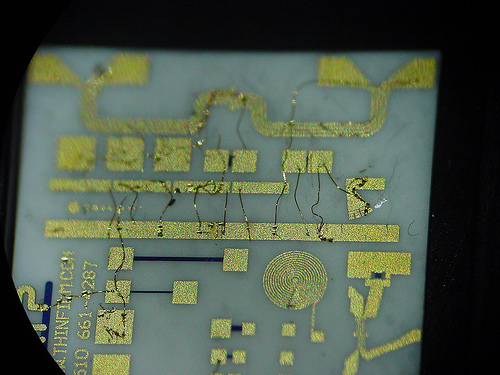
test bonds

My first test bonds on an alumina ceramic substrate (ugly)

To make the best use of the sections that I bought I decided I needed to cut them to length.  Well how do I do that?  The thickest pieces are 10 mils thick (a piece of printer paper is 4 mils thick) and they are brittle!  Beyond cutting, how do I hold the piece while cutting and when it’s done?  The resulting pieces may be just 100 mils long, and 50 mils wide.   Obviously a pair of vice-grips simply won’t do.

So my first thought was a Dremel tool and tape.  This method could work, but it does not lend itself well to making measured cuts.  At 47 GHz, a few hundredths of an inch is a lot! Also, the available diamond blades for dremel tools are fairly wide and I wanted to waste as little of the  small substrates as possible.  At this point I made  a lucky find on eBay.

In the semiconductor industry, one of the last steps of making a chip is called “wafer dicing.”  After a wafer full of chips is made, they need to be cut out into individual parts.  To do this, wafer dicing machines were developed.  These are CNC saws that use a high speed (as high as 60,000 rpm) air bearing spindles with diamond abrasive blades.   They can cut lines across large dinner plate sized wafers that are as narrow as only a few tens of microns.   Luckily there is enough wafer dicing going on in the world that there is a source of surplus blades on eBay.  Not all blades are well suited for all materials, so do some research if you are interested.  Disco (a Japanese company) is one of the largest dicing blade manufacturers.
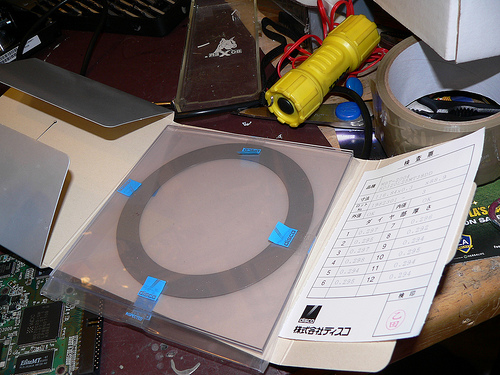
dicingblade

Large (4.6 inch diameter) wafer dicing blade in it's packaging.

While reading the last paragraph you may have spotted a few words indicating unobtanium.  Those words are “high speed air bearing spindle.”   Well I chose to use a hard drive motor instead, because they have excellent bearings and are readily availble  for free.  While they don’t move as fast, I don’t care.  I have a few short cuts to make, not millions of chips.

So that is an introduction to what I’m doing.  For the most part the saw has been built using surplus parts and remnant pieces of metal from my favorite local metal supply house M&K Metals in lovely Gardena, CA.   As of this entry, the saw is nearly complete, all that is left is the splash guards.  I’ll be posting the build of this project in several parts, so stay tuned.

And a link to my Flickr photo set for this project: Dicing saw

-Tony
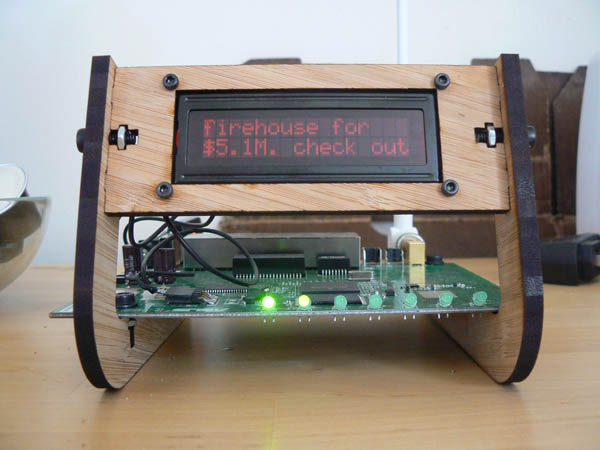
David Nichols’ Tweetster, a wireless Twitter display

Tuesday, July 28th, 2009

David Nichols made this awesome wireless twitter display by combining a hacked Asus WL-520gU wireless router with a Sparkfun serial-enabled LCD display.  The router is running the same OpenWrt distribution I used for my Wifi Radio project, plus a USB thumbdrive that provides some additional flash storage space.  I really like the custom laser cut base that holds the LCD display and the router!

For more pics and info, check out David’s flickr set for the project.

via Make: Online – Tweetster – Wireless tweets display

Celebrating one year of hacks and projects at mightyohm.com!

Monday, July 20th, 2009

Wow!  I can’t believe it’s been a year!

Based on the date of my first post, last Wednesday marked the one year anniversary of my blog.

While I pour a toast, here are a few highlights of the past year:

PID Controlled Solder Paste Fridge

PID Controller closeup

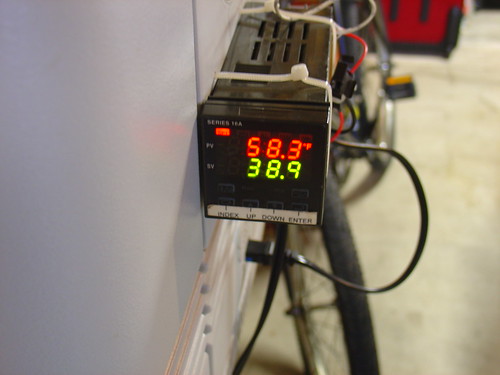
The first project I documented on the site, my solder paste fridge was the end result of a weekend effort to turn an old beer chest into a PID-controlled Peltier cooler for storing tubes of solder paste. A year later, the cooler has a permanent home under my workbench and is still going strong, keeping its contents at a chilly 36 degrees F. Besides solder paste, I keep my POR-15 rust proofing epoxy paint and a few tubes of superglue in the fridge (they never dry out!).
Space Invaders!  Making RGB video with the PIC

I needed an excuse to learn assembly language programming on the PIC, and this project fit the bill perfectly.  Instead of slogging through yet another PIC tutorial I decided to “just do it” and the video above shows the result.  One of my favorite projects of last year, I have plans to build more of these and make some electronic artwork for the lab.

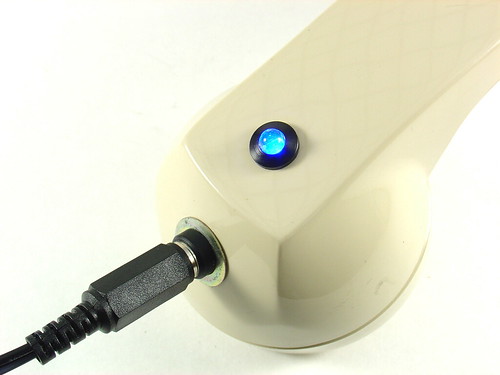
Bluetooth Handset Hack

Charging

One aging bluetooth headset plus one obsolete telephone handset equals one retro-fabulous hack that I still use today.  The best part: Look for this one in Make: volume 20!

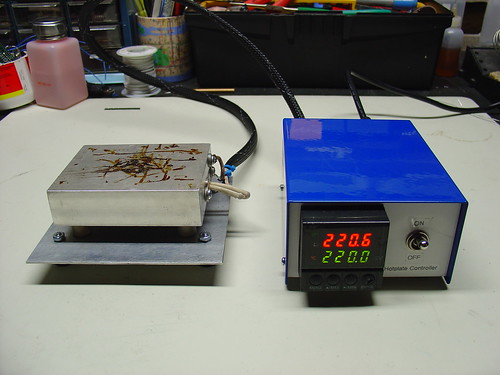
DIY PID-Controlled Soldering Hotplate

PID Controlled Hotplate

I’m a big fan of the hotplate (aka reflow skillet) method of surface mount soldering.  Over the course of a few months I designed, machined, and assembled this PID-controlled soldering hotplate to help build the first few prototypes of my AVR HV Rescue Shield kit.  Hacking around in the garage is always fun, but creating a new tool is one of the most rewarding things I have can think of.

Here’s a video of the hotplate in action, reflowing the step-up converter on the Rescue Shield:

The AVR HV Rescue Shield

AVR HV Rescue Shield

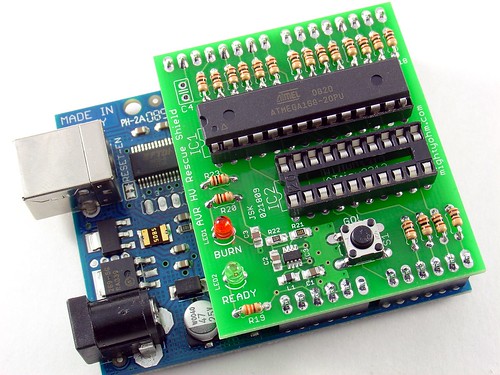
What started as a simple hack to save a crippled AVR microcontroller eventually became a kit that I’ve sold to AVR enthusiasts around the world.  The AVR HV Rescue Shield includes a cool custom PCB, integrated 5V-12V step-up power supply, and is completely open source.   I only made one batch of these, and when they’re gone, they’re gone, so head over to the AVR HV Rescue Shield product page to order one today!

Wifi Radio Project

Finished Wifi Radio

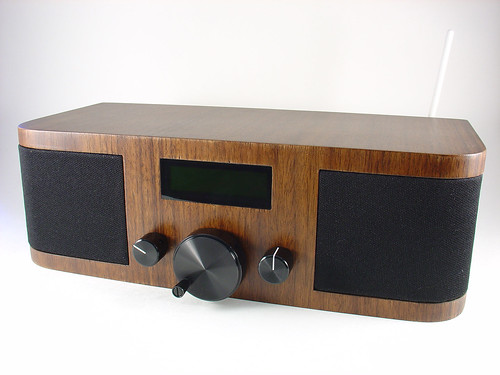
Certainly the most famous project on the site, my Wifi Radio project has inspired many readers to start playing with cheap wireless routers and embedded Linux.  If you haven’t seen it before, the finished project sounds something like this:

I brought the Wifi Radio to the Maker Faire in San Mateo in May.  Everyone loved it, including some of the Make: staff, which got me a blue ribbon for the project.  Awesome!

Onward!

Well, that’s it for year one…  If I missed one of your favorite posts from the past year, leave a comment!  If you’re new to the blog, happy reading, you have some catching up to do.  :-)

Here’s to another fantastic year of hacks, projects, kits, tools, and resources at mightyohm.com!

Building a Wifi Radio? Leave a comment here!

Tuesday, July 7th, 2009

Did my Wifi Radio project inspire you to buy a wireless router and start hacking?  If so, I’d like to hear from you!

Leave a comment below and let me know how your project is coming along.  Even if you’re not building a Wifi Radio but used my firmware or tutorials as a starting point (a great example is the Tweet-a-Watt), I’d love to hear from you.

If you have photos of your project, you can share them with the world by adding them to the Asus Wireless Router Hacks photo pool on flickr.

www.flickr.com

items in Asus Wireless Router Hacks More in Asus Wireless Router Hacks pool

Atmel retiring ATmega48/88/168 microcontrollers

Friday, July 3rd, 2009

Atmel AVR Microcontrollers - Mature Devices

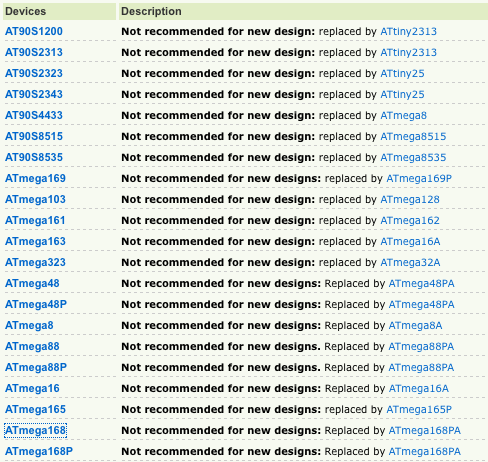
Has anyone else noticed that the ATmega48/88/168 family of 8-bit AVR microcontrollers recently joined Atmel’s “mature devices” list, shown above?

Truthfully, I was not surprised to see this, having been tipped off by an Atmel sales rep earlier this year at ESC in San Jose.

The good news is that while these much-loved ATmega devices are slowly being obsoleted, they are being replaced by the largely-identical ‘PA’ series, which includes the ATmega48PA, ATmega88PA, ATmega168PA, and the ATmega328P.  The ‘PA’ devices are enhanced versions of the former ‘P’ series, which added energy-saving picoPower functionality to the original devices.

Porting code to the new family should be fairly straightforward given that the PA family is designed to be a drop-in replacement.  To help with the switchover, Atmel has released some migration notes, including AVR512, “Migration from ATmega48/88/168 to ATmega48P/88P/168P” and AVR528, “Migrating from ATmega48/88/168 and ATmega48P/88P/168P to ATmega48PA/88PA/168PA“.  Regardless, check your header files and fuse bits for any changes.

If you are anxious about switching devices, don’t panic, the ATmega48/88/168 devices are still in stock at all major distributors, while the PA devices aren’t even on the radar yet.  While professionals might want switch AVRs for new designs, hobbyists will likely still be using the older devices for years to come.  (Long live the PIC16F84!)


www.flickr.com
mightyohm More of mightyohm