All posts by Jeff

Electrical engineer, tinkerer, maker.

My new oscilloscope – the Agilent DSO1014A

New Oscilloscope

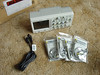
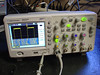
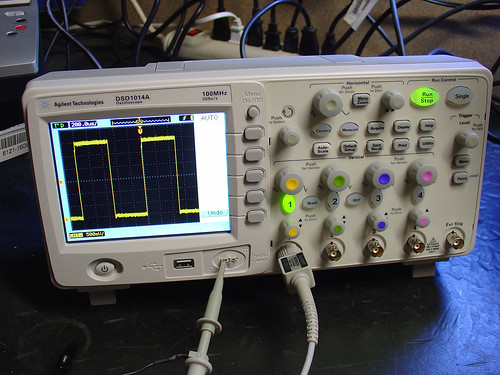
Over the Memorial Day weekend I had a chance to spend a little bit of time with my new Agilent DSO1014A oscilloscope.

The Agilent 1000 family was just introduced on May 4th, 2009.  Since it’s a brand new model, I had to look around a bit to find one in stock at one of Agilent’s distributors.  Agilent quoted a 6-8 week leadtime and said I probably wouldn’t be able to find one anywhere before late June, but with a little searching I spotted one at Newark Electronics.  Two days later, it was running a self calibration in my lab.  Thanks, Newark!

The DSO1014A is a digital storage oscillscope.  The primary advantage of a digital oscilloscope over a traditional analog scope is that waveforms can be easily captured and analyzed even after the original signal is long gone.  Brief transients in the input signals can be viewed by carefully triggering a digital storage oscilloscope.  This is almost impossible to do with a simple analog scope.

Here’s a brief feature list for the DSO1014A along with some of my notes:

  • 100MHz bandwidth (the higher end DSO1024A has 200MHz BW)
  • 4 channels (most low cost scopes only have 2, this was a big selling point)
  • 1GS/s sampling rate per channel (pretty standard), 2GS/s in half channel mode (impressive!)
  • 10kpts/channel record length, 20kpts/s in half channel mode (another big selling point for me)
  • front panel USB connector for recording screenshots to USB stick (yes!!!)

This scope will be a huge upgrade from the analog scope I have been using (an ancient 20MHz Hitachi V212).  While it won’t be able to view USB 2.0 eye diagrams, it should be more than good enough for general purpose use around the lab.

To see more photos of the scope, check out the full album on Flickr.

New Oscilloscope
New Oscilloscope
New Oscilloscope
New Oscilloscope

New Oscilloscope
New Oscilloscope
New Oscilloscope
New Oscilloscope

Video of my NOTACON talk now online

This week I finally got a working copy of the video of my talk from NOTACON 6 about hacking the Asus WL-520gU wireless router.  You can either watch the embedded video above or follow the link below to Vimeo.  If you don’t like either option, you can also download the m4v source file from here (thanks Vimeo!).

Special thanks to Media Archives for recording my talk!

NOTACON 6 – Hacking the Asus WL-520gU Wireless Router from MightyOhm on Vimeo.

Keith’s Hotplate and PID Controller Teardown Pics

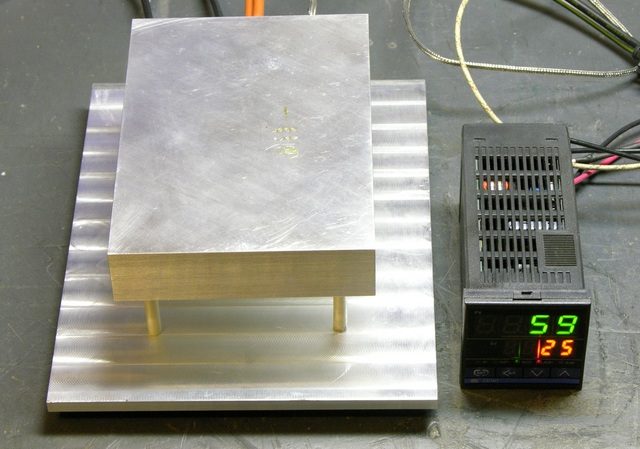
Keith of Keith’s Electronics Blog made a PID-Controlled Soldering Hotplate based on the one I fabricated earlier this year.  He’s already using it to build the stepper controller PCB for the MakerBot CupCake CNC!

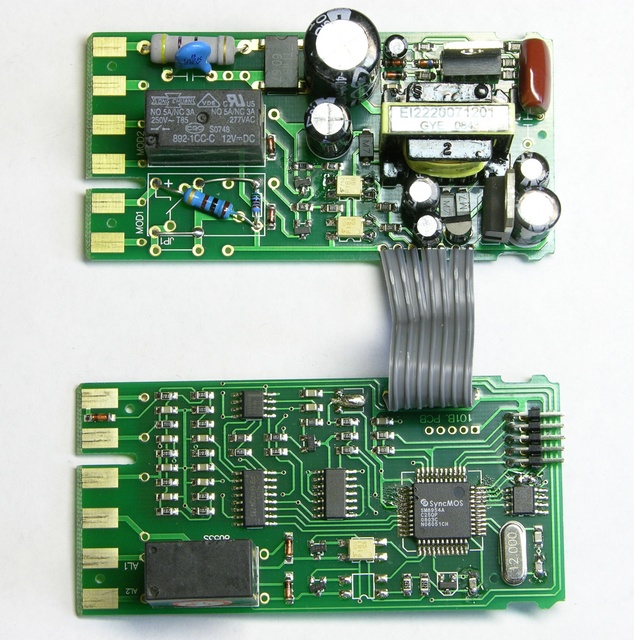
He also posted a bunch of teardown photos (like the one shown below) of the CD101 PID Controller from Sure Electronics.  I suspect the CD101 is a cheap knockoff of an RKC PID controller since I can’t find the part number on RKC’s website, even though the front panel clearly says RKC on it.  I guess at $40 you can’t ask too many questions, the price is right…

Copycat PID-Controlled Solder Hotplate « Keith’s Electronics Blog.

Book Review: Hot Air Rises and Heat Sinks, by Tony Kordyban

Everything You Know About Cooling Electronics Is Wrong
Everything You Know About Cooling Electronics Is Wrong!

Working as an electrical engineer, I have often been faced with thermal design problems. They are usually in the form of: “Given a maximum system temperature X, ensure that the maximum temperature of all devices in the design does not exceed Y.”  Temperature X is usually a customer spec, while temperature Y is almost always driven by MTTF constraints on the semiconductors used in the design.  This sounds simple enough until you realize that:

  • The system temperature is often not clearly defined.  Is it the ambient air temperature?  The temperature of the printed circuit board the part is mounted on?  The temperature of a baseplate (usually a sizable piece of aluminum) that won’t even exist in the finished design?
  • The MTTF spec is usually based on things you can’t measure directly (at least not easily or accurately), like the junction temperature of a transistor that is on a die you can’t even see, inside a package you don’t have a thermal model for.  In addition, MTTF numbers are often wildly inaccurate, don’t account for duty cycle, etc.  Yikes.
  • Chances are, the guy who worked on the part before you hasn’t checked the thermal readings in years, so it’s actually running way over the limits, and now you have to fix it.  A small change in the design can drastically affect the numbers

At the end of the day, numbers are scribbled on envelopes or entered into spreadsheets, guesses estimates are made, and everyone resolves to develop a better thermal model next time, which of course never happens.

I stumbled upon this book at the Stanford University Bookstore a few months ago.  Given my experience (frustration) with thermal design, I couldn’t help but pick it up and start reading.

It’s a fairly quick read and thoroughly entertaining.  Kordyban’s style is very informal.  The chapters are in the form of several short stories about fictional characters at a made-up company called TeleLeap.  These characters have to solve a series of design problems, which are used as examples to explain several concepts of thermal design.  There are no lengthy derivations and the technical discussions are pretty understandable, even to someone who never took thermodynamics in college (like me).

In particular, I found Kordyban’s discussions of the errors that can creep into thermocouple measurements, the difficulty of measuring junction temperature directly, and the problem with pin-fin heatsinks very interesting and educational.  I won’t say that I am an expert in thermal design having read this book, but I do have just a little bit more insight into what’s going on (and what to avoid).

Unfortunately, the book is out of print, so you’ll have to find a used copy and pay some big bucks – unless you get lucky like I did and find one that’s still sitting on the shelf.  No, you can’t have mine!

Hot Air Rises and Heat Sinks: Everything You Know About Cooling Electronics Is Wrong